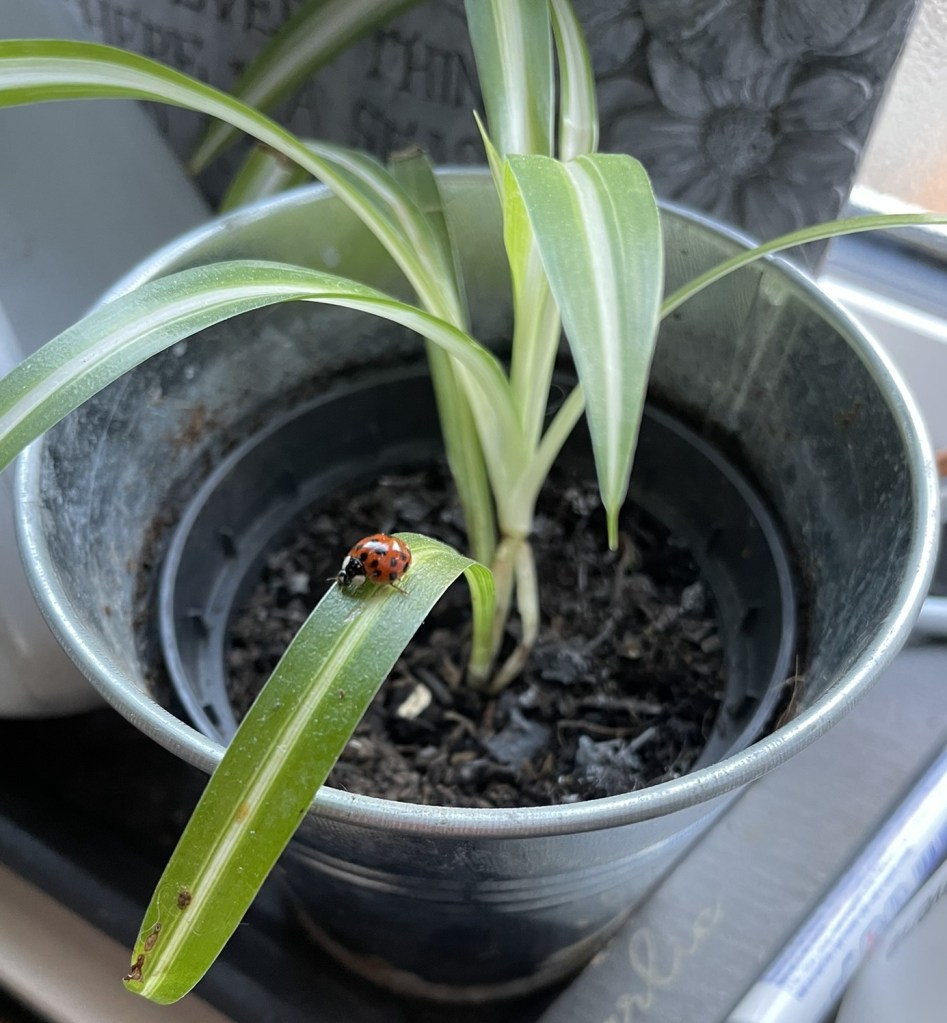
I have a new lodger – a lone ladybird – currently residing on my little spider plant. Ladybirds come in a variety of colours – most commonly red, orange and black, and each species sports a different number of spots. My visitor is red and looks to have the 18 spots required to be a Harlequin ladybird. I say she, but I actually have no idea if it’s a male or female – to tell you’d need to have one of each to compare for size and length of antennae (this reminds me of my magpie blog). The Harlequins arrived in this country about 20 years ago and have suffered a bad press in the past. They feed on aphids like the other 40+ species found in the UK, so that’s good. But, they do also feed on the eggs and larvae of butterflies and moths and on small insects including, horror of horrors, other ladybirds! So it was thought the Harlequins might lead to the extinction of our native ladybirds, but apparently the evidence is mixed, with some species showing no decline. Research is ongoing.
Ladybirds look for shelter in autumn/winter and often find it in our homes. They generally huddle together in a corner and go into a dormant state until the spring. So I’m worried about my ladybird. Has she got lost and separated from her friends and family? If she has, I haven’t found them yet. Maybe she’s come to the wrong house – or maybe they told her the wrong address because they don’t like her? I hope she’ll be OK here. If you find ladybirds and you don’t like them being in your house, please don’t kill them. Just collect them up and put them outside where they’ll find alternative shelter.
I think ladybirds appeal to all ages and this has been put to profitable commercial use. I well remember being dressed in Ladybird clothes when I was young and of course reading all those Ladybird books! I do find the old nursery rhyme rather sad though:
Ladybird, ladybird, fly away home,
Your house is on fire and your children all gone,
All except one and that’s little Anne,
And she’s crept under the warming pan.
There are many regional variations of the rhyme – I rather like this Yorkshire one because it gives hope for the fate of the children and Nan is keeping herself busy until her mum finds her:
Ladybird, ladybird, flig thy way home;
Thy house is on fire, thy children all roam,
Except little Nan, who sits in her pan,
Weaving gold laces as fast as she can.
That’s it, as I live in Yorkshire, I’m going to name my guest Nan and I’ll teach Little Bud the Yorkshire version!
Now if there are any children reading or listening, you might want to censor the next bit, because ladybirds are very promiscuous! They mate a lot and they’ve certainly got stamina – they can be at it for as long as 9 hours at a time, with 2 or 3 hours being the impressive average! So, it’s not surprising they have become associated with love and luck – they are thought to be able to show you which direction to travel in to locate the love of your life.
It being nearly Christmas, I feel I must turn to the strong connection ladybirds have with religion. In England the name ladybird is an adaptation of Our Lady’s birds – Our Lady being the Virgin Mary. In this case we’re talking a very common 7 spot species – the red colour is supposed to represent the red cloak the Virgin Mary is often seen wearing in paintings, and the 7 spots are said to signify her 7 joys and 7 sorrows. Some Scottish people call ladybirds ladyclocks – clock being a corruption of cloak.
GR, Rosie, Daisy, Little Bud and Lily join me in wishing you a wonderful Christmas and a happy and healthy 2025.


 Rambling Rose
I wish your lone ladybird a happy winter break 🐞.
Merry Christmas 🎄🥳
LikeLike
Yes I hope s/he will be very comfortable here 🤞x
LikeLike
Very informative! How did you manage to count all those spots. I don’t think I’ve seen a ladybird with so many spots…And who knew about their other proclivities? And I love the alternative regional version of the rhyme Ladybird Ladybird
LikeLike