Snowy Weather and a Super Spreader

Did you get hit with snow on 5 January? You did if you live in Harrogate like I do. It felt as though all the available snow in the sky was dumped on us. North Yorkshire Council was heavily criticised for inadequate efforts to prepare for the forecast snow, and not making the roads and pavements safe once the snow became compacted ice. Defending themselves, they described the snowfall as “the worst since the Beast from the East in 2018“. Temperatures plummeted as low as -11, so the snow quickly turned to ice, so thick it was like trying to dig concrete.  Living on our road is like living on a steep hill in Narnia. We’re only a few hundred yards from a main road, but we were unable to dig our cars out and rejoin civilisation for a week. Trying to walk anywhere was perilous – the side roads and pavements were covered in thick compacted ice. After a few days of searching, I found my crampons – I think I probably bought them after the Beast from the East experience. The first challenge was to get them onto my boots – they’re a tight fit. I needed the help of 2 pairs of pliers, all my strength and a lot of swearing  to get them on. It didn’t help that I put the first set on the wrong way round. As I picked up the next one I noticed they are clearly marked BACK and FRONT. Anyway, crampons are great for walking on snow and ice but not for traversing hard surfaces, and I’m afraid after the effort to get them on, I was past caring if I ripped my local Co-op’s flooring to shreds.

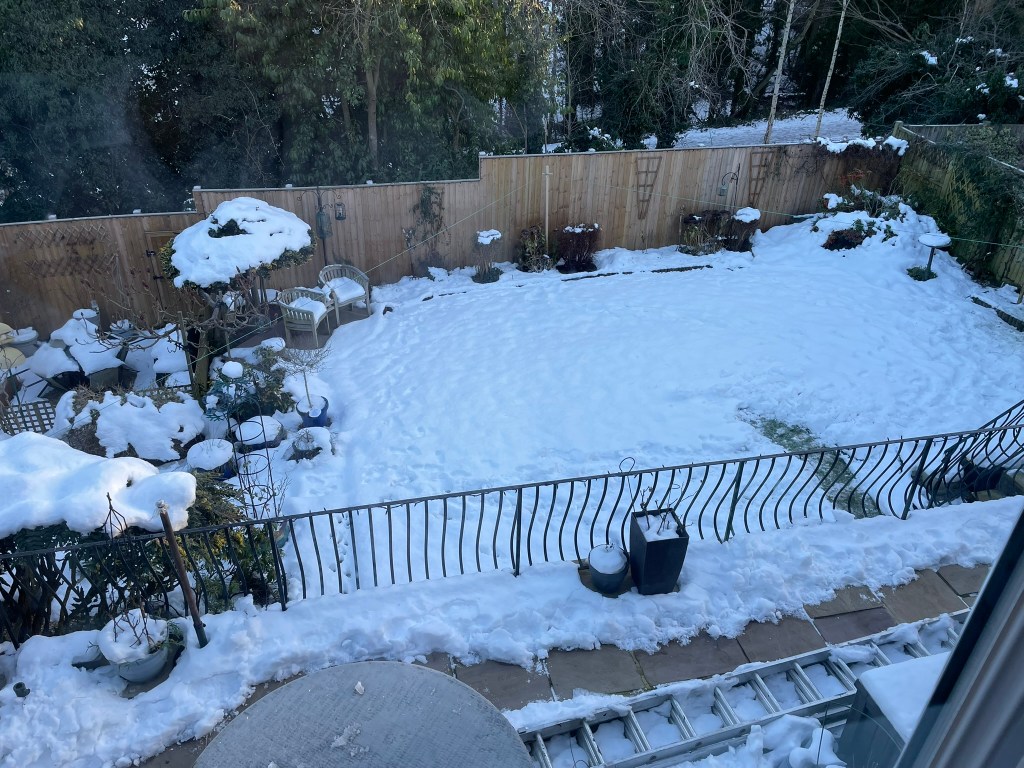
Lily was traumatised by the snow when it first fell. She sunk up to her armpits and was unable to move. When it became icy she couldn’t stand up on it, so I had to dig her a little pathway across our terrace, and clear a small patch of grass for her to wee and poo on. She still went round and round in circles in the space allowed, before deciding on the perfect spot. GR valiantly ventured out with a broom to relieve Ceanothus of the weight of snow and tightened up her supporting ropes. The photo below is of the back garden a week after the snow fell. A few days later we experienced near tropical temperatures (+10) and it all disappeared as if by magic – who says there’s no such thing as global warming?

Little Bud was subjected to being a snow angel by his parents – he didn’t look impressed. However, he got his own back. Having suffered a day of being a little out of sorts, he passed on a vicious D & V bug to Rosie and Daisy, Daisy’s parents, her sister and me. Perhaps we should rename him Little Bug. GR conveniently missed this treat as he was on a ski slope somewhere in Austria. I forgave Little Bud and he came to stay with me overnight, while his parents had time away celebrating Daisy’s birthday. He was a model child for his granny and even did some horticultural reading during his stay, in preparation for becoming my gardening assistant once he can walk.

Lady in red

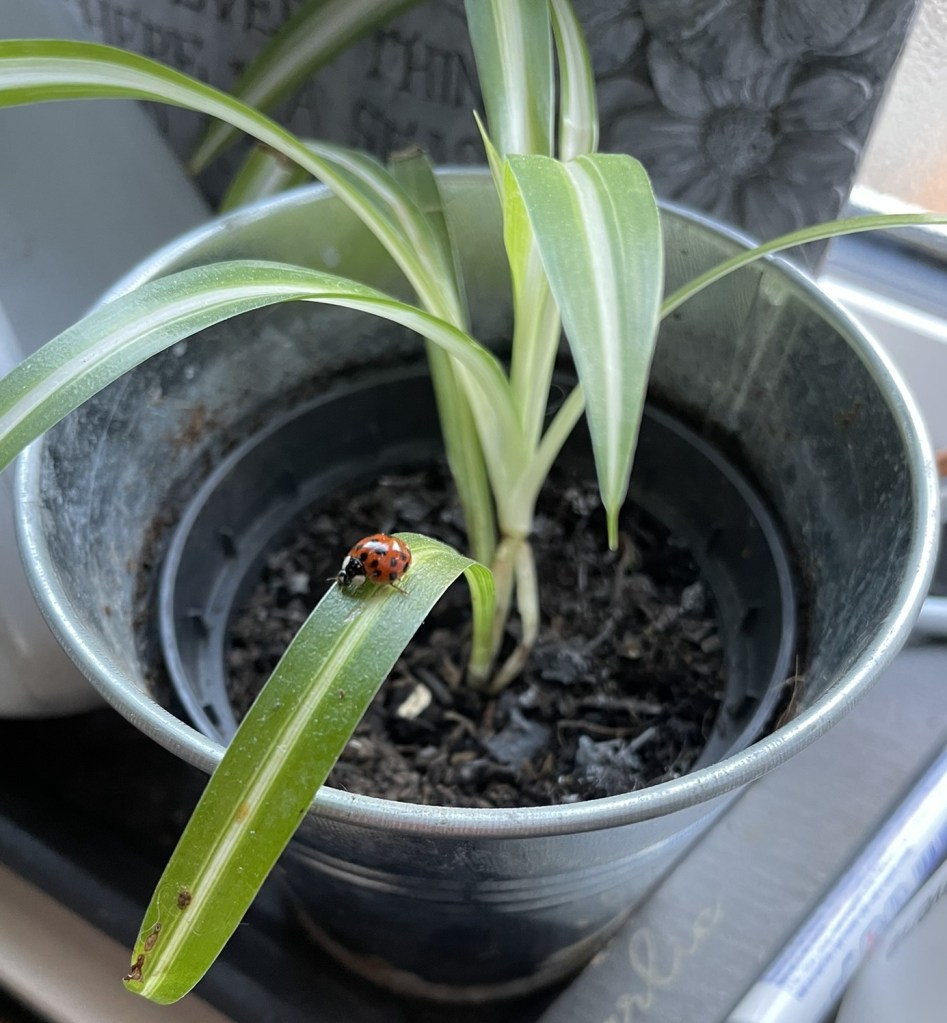
I have a new lodger – a lone ladybird – currently residing on my little spider plant. Ladybirds come in a variety of colours – most commonly red, orange and black, and each species sports a different number of spots. My visitor is red and looks to have the 18 spots required to be a Harlequin ladybird. I say she, but I actually have no idea if it’s a male or female – to tell you’d need to have one of each to compare for size and length of antennae (this reminds me of my magpie blog). The Harlequins arrived in this country about 20 years ago and have suffered a bad press in the past. They feed on aphids like the other 40+ species found in the UK, so that’s good. But, they do also feed on the eggs and larvae of butterflies and moths and on small insects including, horror of horrors, other ladybirds! So it was thought the Harlequins might lead to the extinction of our native ladybirds, but apparently the evidence is mixed, with some species showing no decline. Research is ongoing.

Ladybirds look for shelter in autumn/winter and often find it in our homes. They generally huddle together in a corner and go into a dormant state until the spring. So I’m worried about my ladybird. Has she got lost and separated from her friends and family? If she has, I haven’t found them yet. Maybe she’s come to the wrong house – or maybe they told her the wrong address because they don’t like her? I hope she’ll be OK here. If you find ladybirds and you don’t like them being in your house, please don’t kill them. Just collect them up and put them outside where they’ll find alternative shelter.

I think ladybirds appeal to all ages and this has been put to profitable commercial use. I well remember being dressed in Ladybird clothes when I was young and of course reading all those Ladybird books! I do find the old nursery rhyme rather sad though:

Ladybird, ladybird, fly away home,
Your house is on fire and your children all gone,
All except one and that’s little Anne,
And she’s crept under the warming pan.

There are many regional variations of the rhyme – I rather like this Yorkshire one because it gives hope for the fate of the children and Nan is keeping herself busy until her mum finds her:

Ladybird, ladybird, flig thy way home;
Thy house is on fire, thy children all roam,
Except little Nan, who sits in her pan,
Weaving gold laces as fast as she can.

That’s it, as I live in Yorkshire, I’m going to name my guest Nan and I’ll teach Little Bud the Yorkshire version!

Now if there are any children reading or listening, you might want to censor the next bit, because ladybirds are very promiscuous! They mate a lot and they’ve certainly got stamina – they can be at it for as long as 9 hours at a time, with 2 or 3 hours being the impressive average! So, it’s not surprising they have become associated with love and luck – they are thought to be able to show you which direction to travel in to locate the love of your life.

It being nearly Christmas, I feel I must turn to the strong connection ladybirds have with religion. In England the name ladybird is an adaptation of Our Lady’s birdsOur Lady being the Virgin Mary. In this case we’re talking a very common 7 spot species – the red colour is supposed to represent the red cloak the Virgin Mary is often seen wearing in paintings, and the 7 spots are said to signify her 7 joys and 7 sorrows. Some Scottish people call ladybirds ladyclocksclock being a corruption of cloak.

GR, Rosie, Daisy, Little Bud and Lily join me in wishing you a wonderful Christmas and a happy and healthy 2025.

What’s in a name?

Are you old enough to remember the song Tiptoe Thru’ the Tulips With Me by Tiny Tim – if you are, then it’s probably best wiped from your mind screen. If you aren’t, then count yourself lucky! Recently I attended a talk about tulips, delivered by Teresa Clements who is on the Committee of the Wakefield & North of England Tulip Society. It was fascinating, really well delivered and certainly not something to forget.

We learned that a tulip isn’t like a daffodil. With daffodils I’m sure you know that you should leave the leaves to die down after flowering, in order to pass goodness into the bulb, so that it will hopefully flower again the following year. I hadn’t realised tulips don’t grow from the same bulb each year, but make a new bulb, if you treat them in the right way. Ideally, whether planted in the ground or in a pot, they need to be in a nice sunny spot over the summer months – I can identify with that!

Another fascinating fact is that these bulbs were named tulips by mistake! The Persian name for tulip is laleh which sounds a bit like lily. That figures when you look at the shape of the flowers. But the story goes that in the 16th century the Austrian ambassador to the Ottoman Empire got a bit confused. He pointed at tulips decorating workers’ turbans and asked what they were called – the answer was tulipan, so the bulbs became known to us as tulips, but tulipan translates as turban.

Ottoman traders took tulip bulbs to the Netherlands and of course they soon found their way to Britain. A real craze began in the early 17th century, known as Tulip Mania. Tulip bulbs became regarded as an investment opportunity and some varieties commanded staggering prices. They even became a form of currency, properties being exchanged for just a few bulbs! By the 18th century British growers, known as florists began to cultivate tulips from seed, a process that can take up to 7 years to produce a bulb. They obviously had a lot more patience than me, and were off the scale where GR is concerned! Their quest was to enhance the decorative qualities of the flowers to achieve different shades, petal shapes and patterns and to show them off to family and friends. As time went on less wealthy people began to grow and show what became known as English Florists’ Tulips. Originally they were displayed in small stone jars with a narrow neck, which made them hard to fill and empty. Legend has it that one day some children, tasked with emptying them after a show held in a pub, left them in a bag on the street. Horror of horrors, it was picked up by the bin men (that nearly happened to me when a delivery man put a parcel in my wheely bin for safekeeping)! It is said that after the mishap, beer bottles became the display vessel of choice and that tradition continues today.

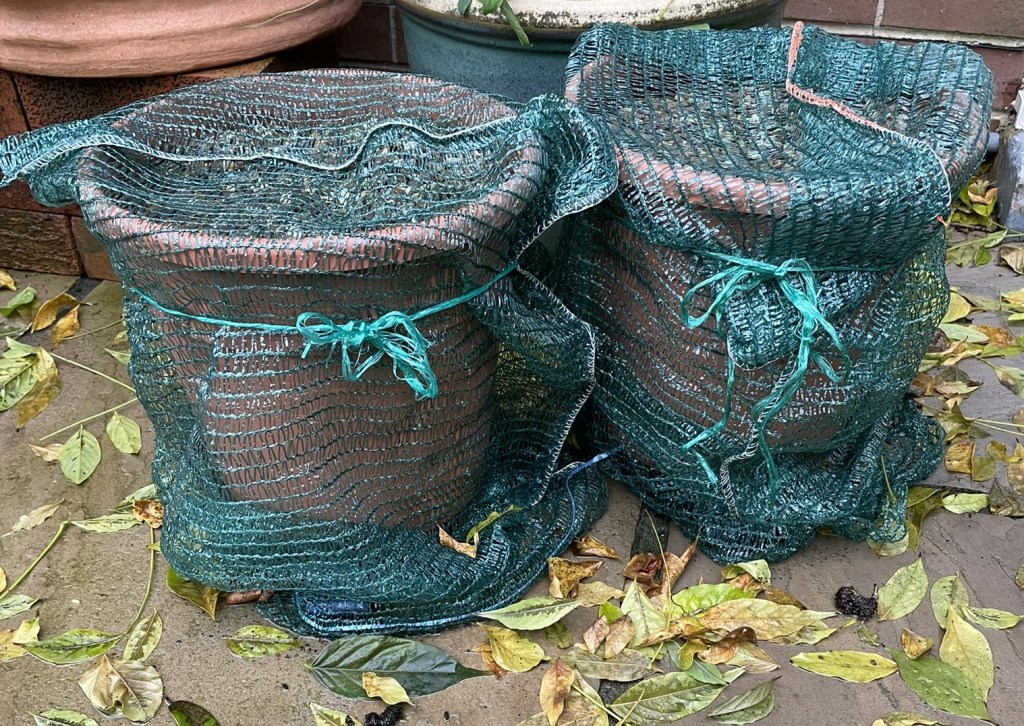
To be honest I’ve not had much luck with growing tulips in years gone by, so I haven’t bothered with them since. Inspired by Teresa’s talk I’ve just planted up some small tulips in pots. You’re supposed to wait until November to plant them, so I dutifully did. Planted too early, they are prone to succumbing to tulip fire, a fungal infection which causes brown spots and rotting – not a good look. Colder temperatures are thought to reduce the risk. But as we know gardening can be fraught with disappointment, so if tulip fire doesn’t get them, there are at least half a dozen viruses waiting in the wings to attack them, and if that fails squirrels and mice dig them up as a tasty treat. I’ve encased my pots in some recycled string bags in the hope the rodents won’t nibble their way through. Victoria has used heavy duty chicken wire – let’s hope both will do the job.

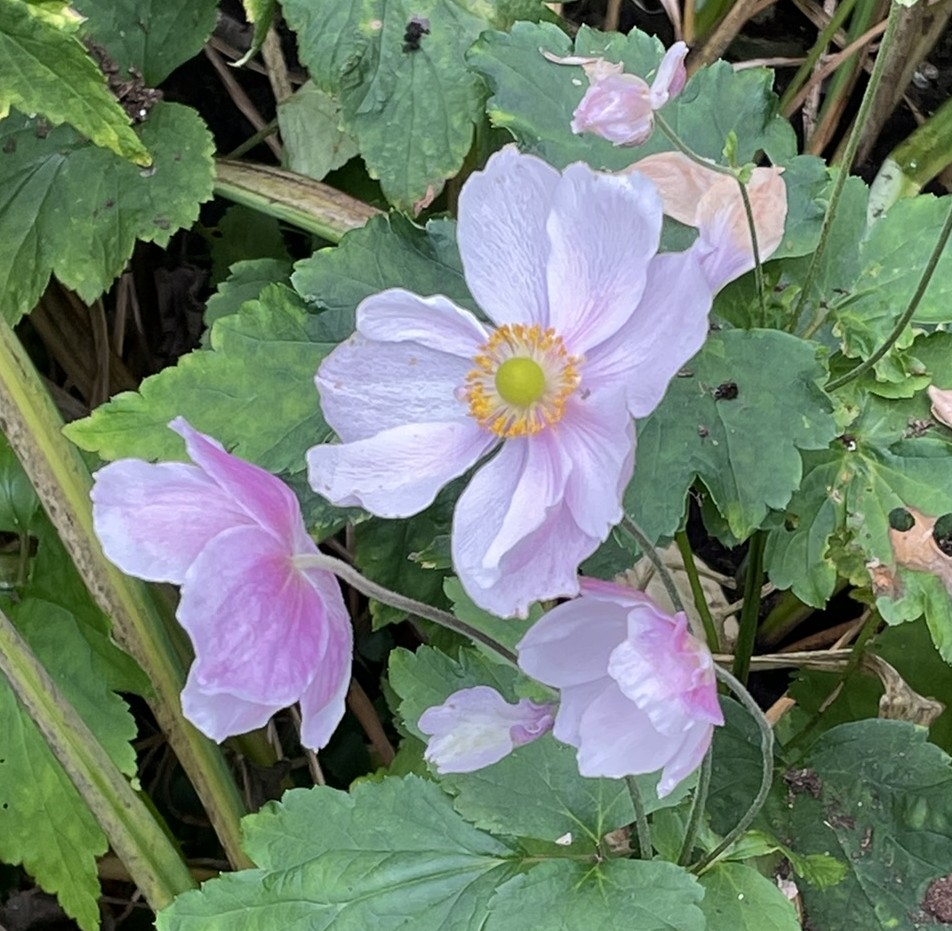
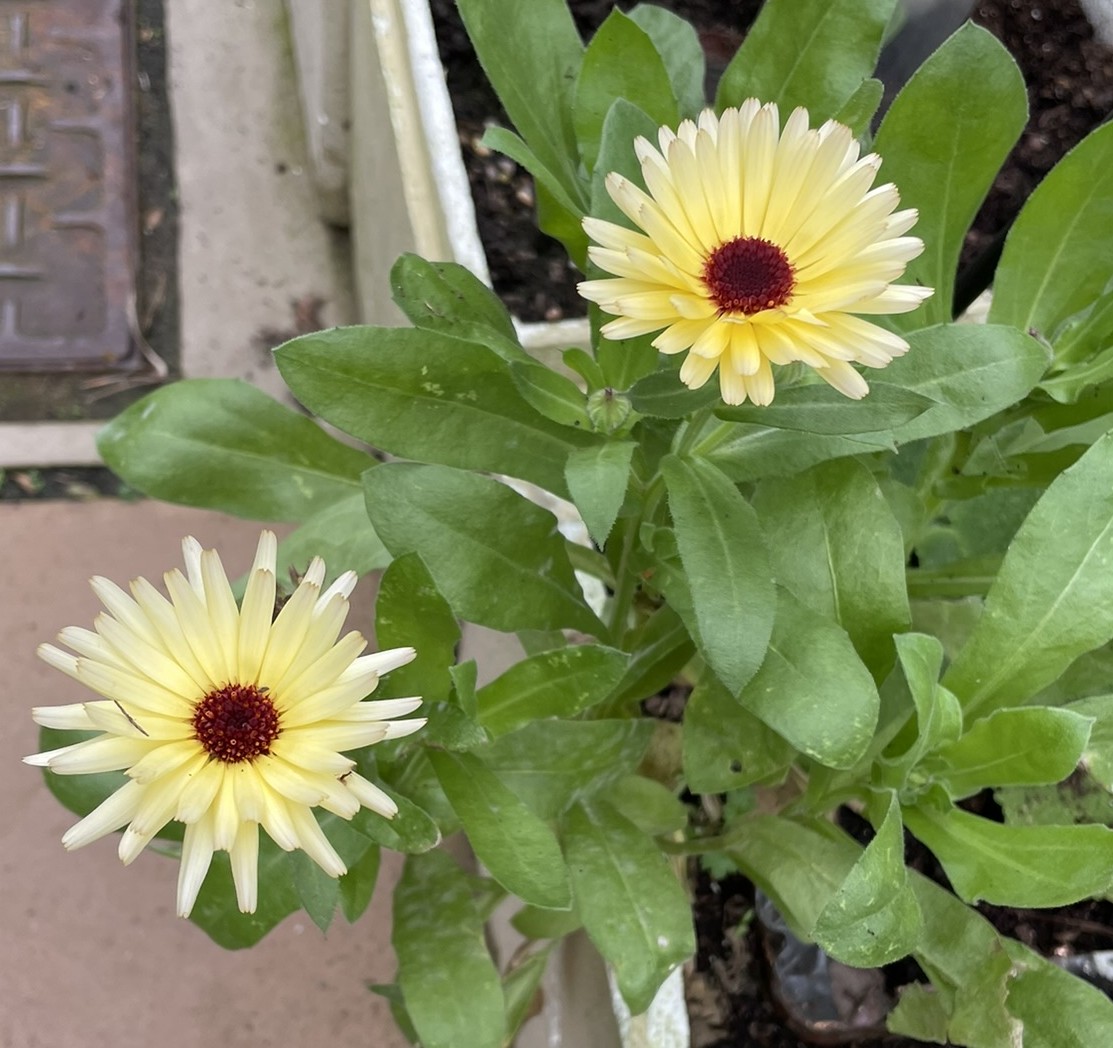
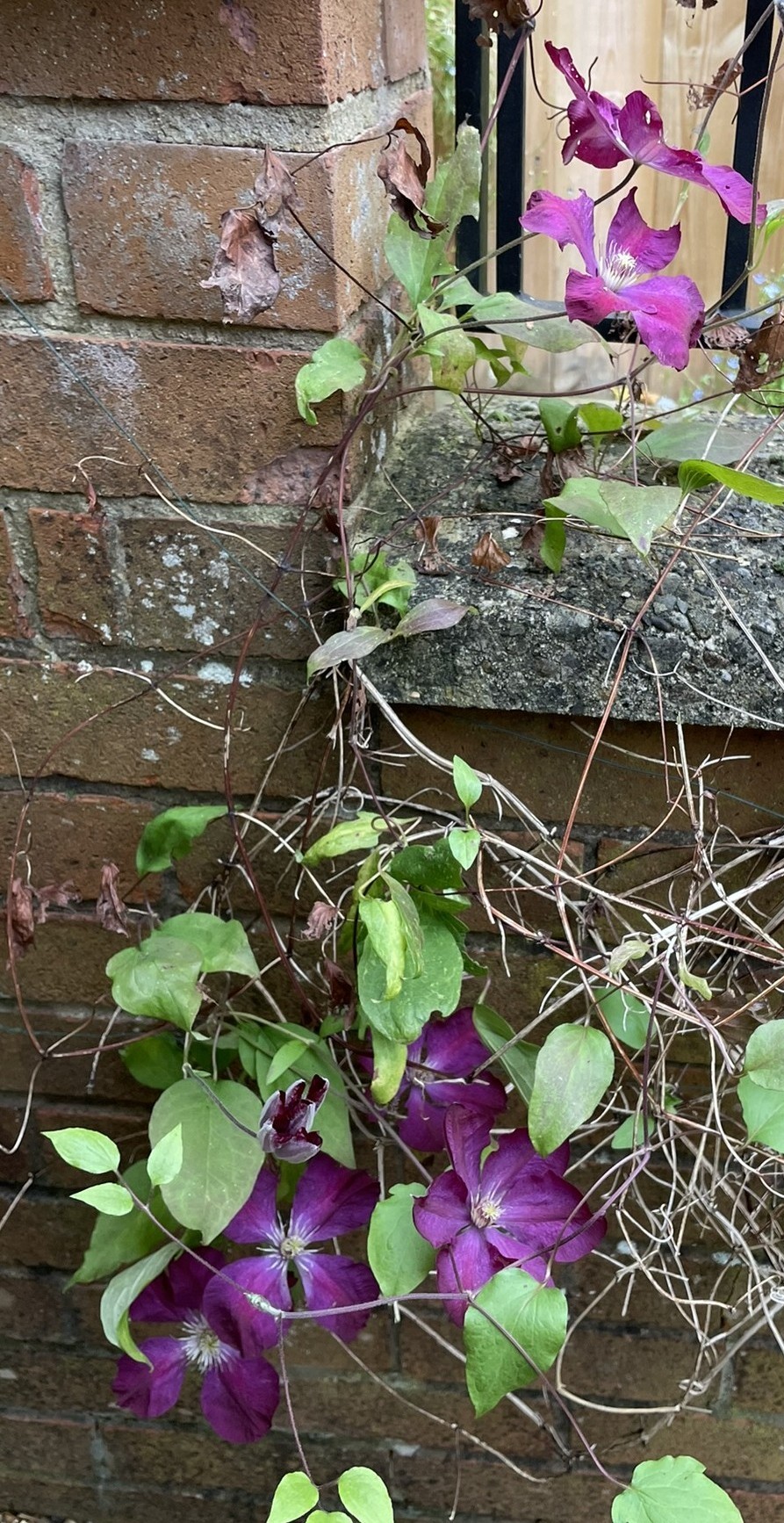
Of course there aren’t any tulips flowering in our borders and pots at the moment, but up until the very recent drop in temperatures, I was surprised how many flowers were still blooming in my garden. Of course Jack and Bert have put paid to all that, but it was lovely to see while it lasted!

October’s good and not so gourd times

I’m a bit later than usual with my blog this month. I’ve had a bit of a mishap. To cut a long story short, I fell and injured some ribs, so there’s not much in the way of gardening going on at the moment.

Anyway, before said calamity, GR and I had a break of a different kind, a relaxing few days away in Aysgarth. Of course we revisited the Falls, very beautiful and famous, not least for a starring role in Robin Hood: Prince of Thieves, alongside Kevin Costner, who sadly wasn’t in evidence. The weather was amazing – I hadn’t thought to take sun cream in Yorkshire in October, so was sporting a farmer’s tan (well actually it was more of a lobster look) by the time we left for home.

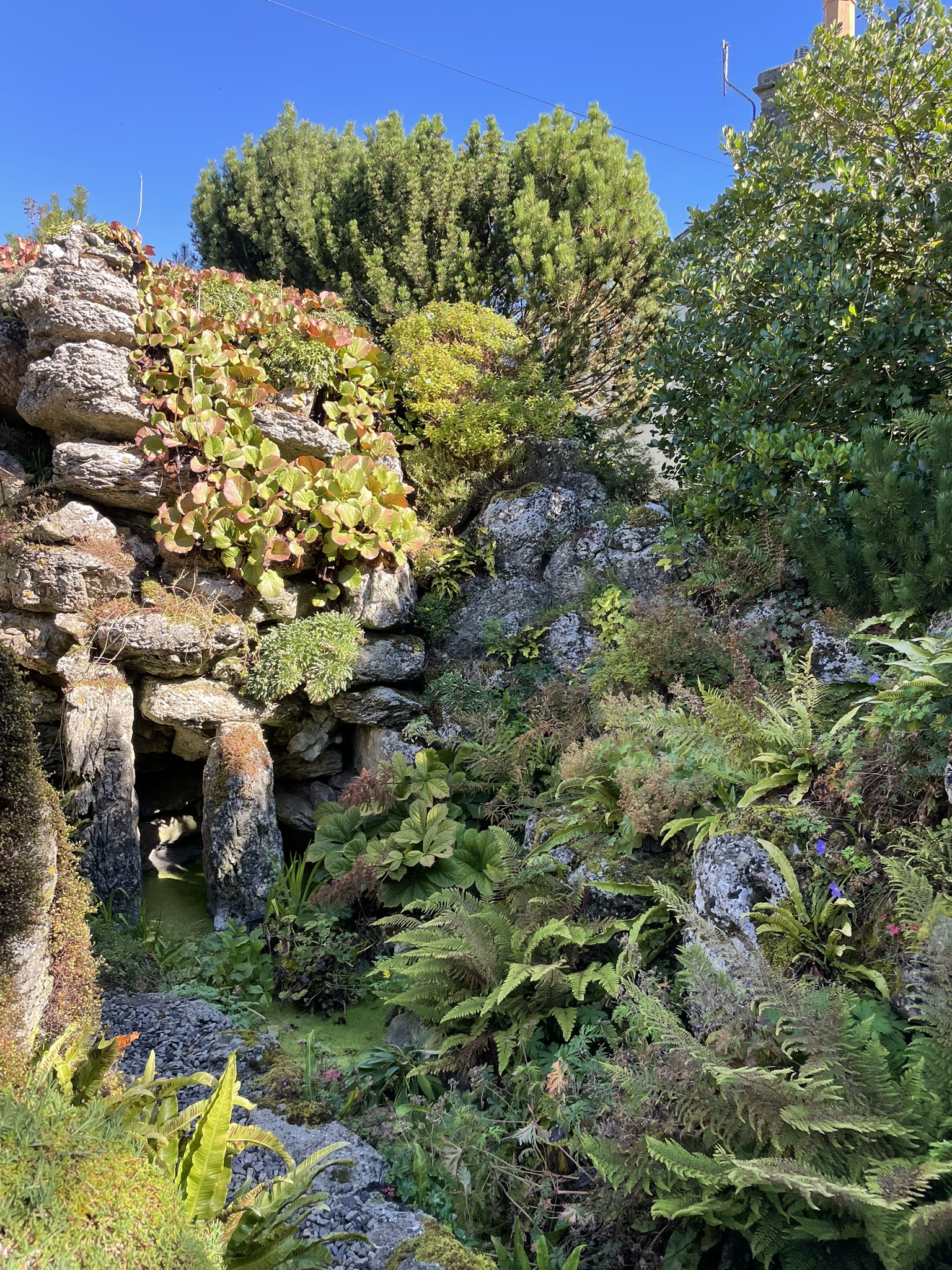
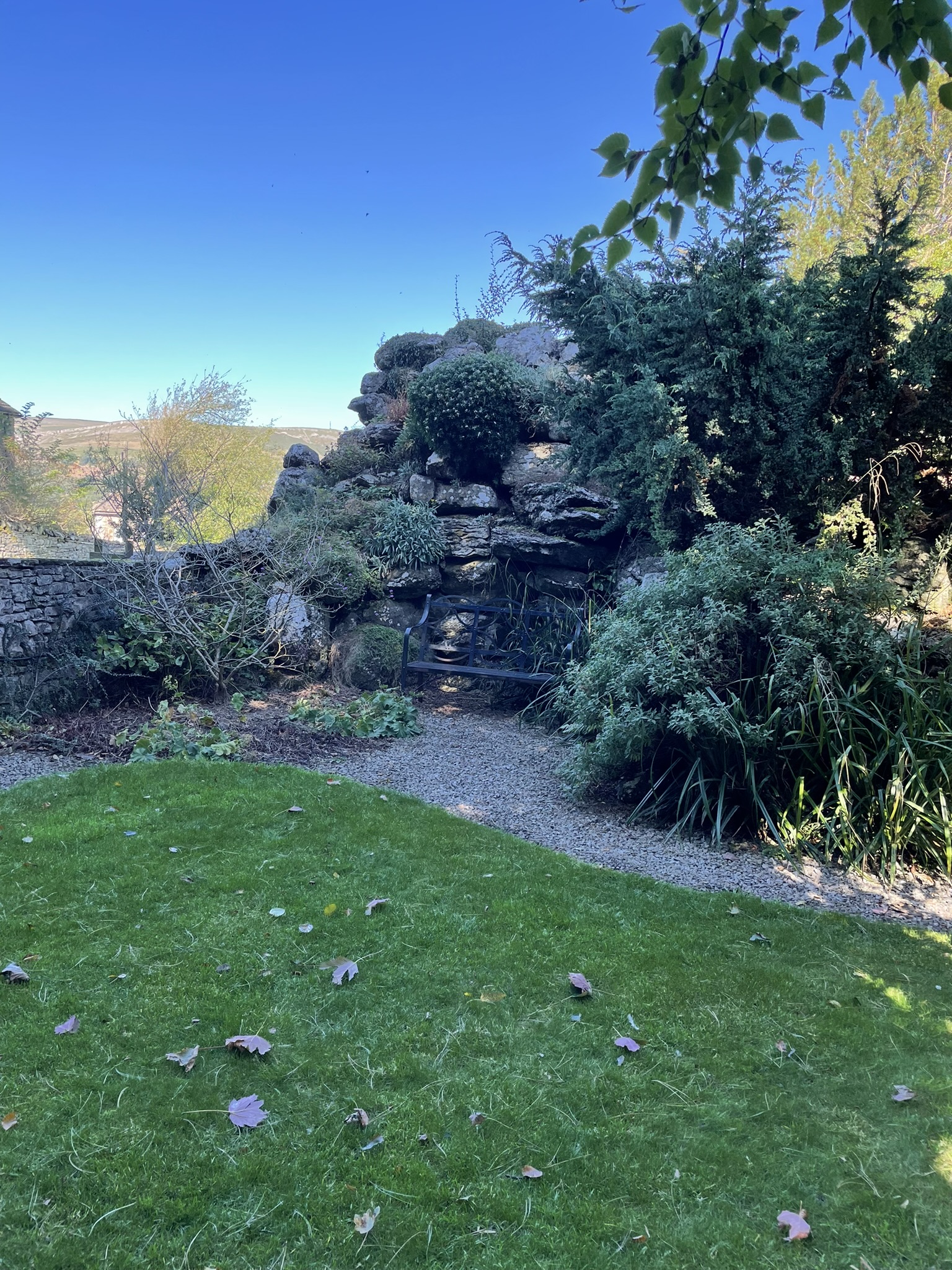
One day we walked from our hotel, across the fields to Aysgarth village. GR had heard about a Rock Garden worth a visit. It was well hidden, but I really do recommend a look if you’re in the area. Just bear in mind that it is quite narrow to negotiate, so you need to be a bit agile – I wouldn’t like to attempt it at the moment! Apparently rock gardens are back in vogue – I wasn’t aware they had ever gone out of favour.

The Aysgarth Rock Garden was commissioned by a local man, Frank Sayer and work started on it in 1906. His interest in horticulture led him to set up his own nursery in Aysgarth. By all accounts he was a bit of a character and by today’s standards his other activities would not sit comfortably with nature lovers. He was said to deal in rare gull eggs and silver rabbit furs, reputedly supplying them to the last Czar of Russia. The local limestone used in his rock garden is now protected by law and should never be offered for sale.

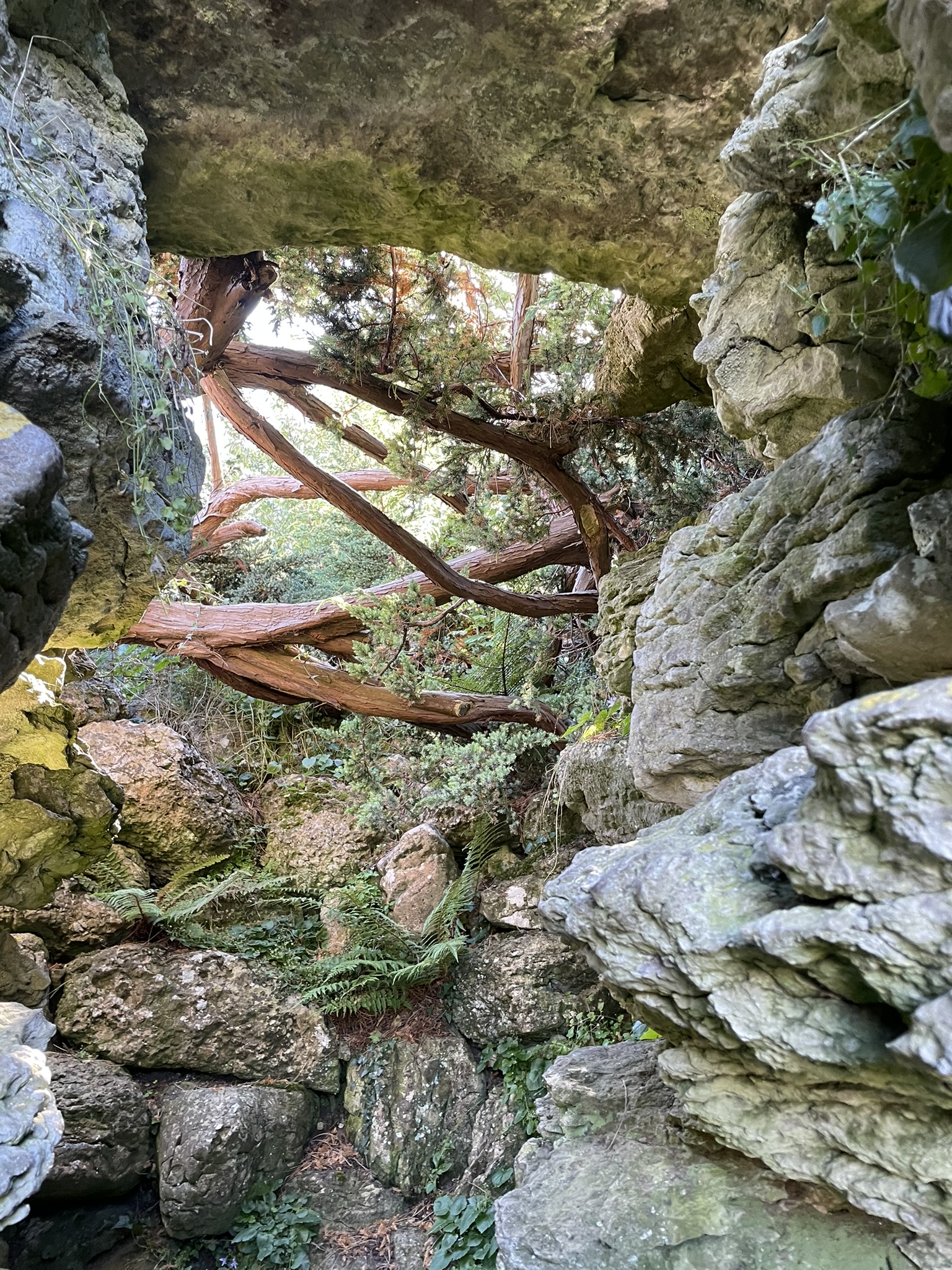
In 2020 the Parish Council took over the maintenance of the garden, the then owners having gifted it to the local community. You won’t be surprised to know that its upkeep relies heavily on volunteers. It’s free to visit but there is a much needed donation box near the entrance gate. The garden really is delightful, as I think you will agree my photos demonstrate. It’s a prime example of ‘small is beautiful’, being only 0.14 acres in size (that makes it sound like I know what that means, which I don’t, but I understand one acre is the equivalent of about 16 tennis courts if that helps). In some ways it seems bigger, as you meander through the narrow pathways and under limestone archways, admiring the alpine plants, before emerging into a small lawned area at the top, with a spectacular view. And, it’s even got it’s own gnome! The garden was once home to a garden gnome business. It took me a while to find the Aysgarth gnome – he’s only about 6 inches tall – well, he’d be taller if he wasn’t headless. You might just be able to make him out in my photo, which I admit isn’t great, on account of it being so beautifully sunny on the day we visited. He could do with a trip to the Gnome Surgery I blogged about some time ago – you can revisit it here.

Aysgarth Rock Garden – what a hidden gem!

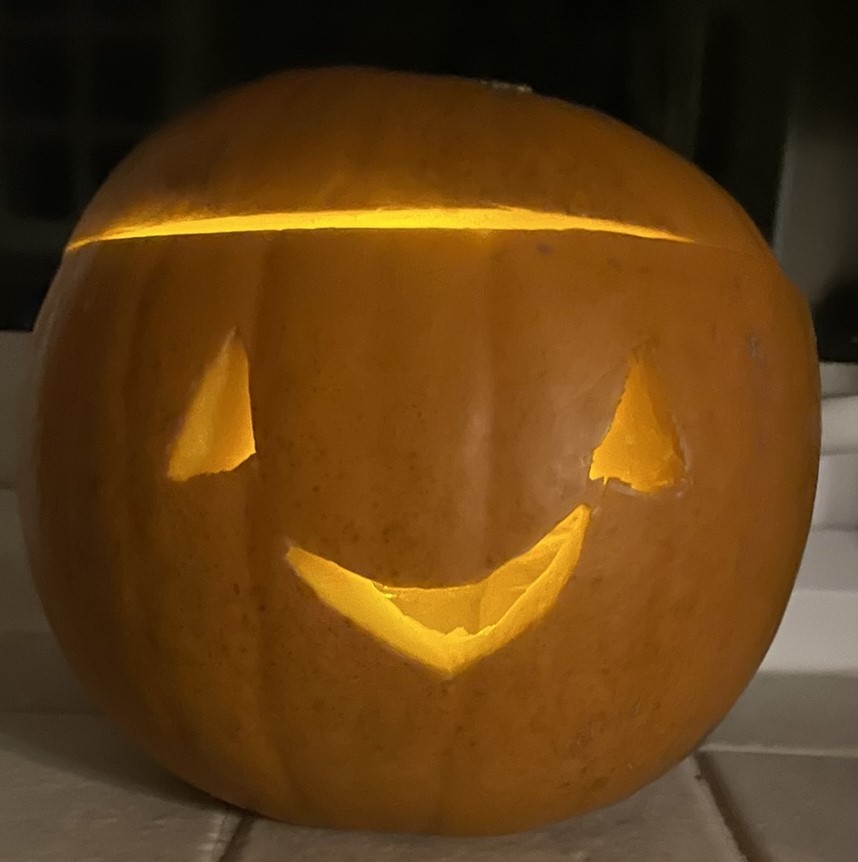
Just to change the subject, as we approach Halloween – being a very organised person, thinking ahead, I bought a tub of sweets last week, ready for Trick or Treat callers – GR has eaten most of them already. Little Bud has been pumpkin picking with Rosie and Daisy and the poor child has been dressed as a pumpkin. To be precise he was put in a real pumpkin, virtually naked, and photographed surrounded by smaller pumpkins – he wasn’t happy, and who can blame him – can you imagine how cold and slimy that must have felt. Fortunately he seemed unscathed after a warm bath, but you know there is such a thing as a fear of pumpkins – it’s called cucurbitophobia!

Where have all the wasps gone?

Many people, I confess me included, consider wasps to be a nuisance – well actually I’m scared of them – is it unreasonable to want to avoid being stung? I wrote about a saga involving our household and wasps a few years ago – you can read about it here if you like.

Now, with my sensible head on, I know that wasps do in fact make a valuable contribution to the natural world – they are pest controllers, pollinators and decomposers – which is why they invite themselves to our meaty barbecues! I learned recently that in this country we accommodate less than 10% of the 100,000 species of wasps and hornets that exist worldwide. Of these only 9 species actually sting. But, they are the ones that at this time of year, seem to be intent on causing us pain, whether that be via an actual sting or the indignity of flapping about trying to escape them, which inevitably causes great hilarity for onlookers. At the end of the nesting season, the adults need sugar, which is why they won’t leave us alone when we’re drinking fizzy pop, beer and the like, or trying to enjoy a cream tea – or in my case today a cheese sandwich laced with M&S plum, ginger and Ruby Port chutney. I have to say this has been the only wasp to bother me in the garden so far this year which is pretty unusual.

So, are their numbers actually reducing enough that we should be worried about it? You may or may not be relieved to know that the scientists think not. Professor Sumner has spent her career studying wasps – a pretty perilous occupation I’d say – I wonder how many times she’s been stung?! She says the cold and the rain we’ve endured this year has made it difficult for the solitary queens to build their nests, so there are fewer nests than usual and therefore fewer wasps.

Other garden pests don’t seem to have been deterred by the weather. The rose sawfly larvae made a sneaky return to the Lady of Shalott. They’ve been despatched over the fence (not Victoria’s I hasten to add) – Captain Tom has grown lots of new leaves by the way. I should have known better than to gloat last time about beating the lily beetles at their own game. They promptly laid as many eggs on my lily leaves as they could muster. I’ve spent hours with my surgical gloves on squashing the grubs, which are concealed in lumps of lily beetle poo. At least that means there are some leaves left to put goodness back into the bulbs for next year’s spectacular display. You can view the little lumps of poo below and the effect the grubs have on the leaves – I really know how to entertain you don’t I?

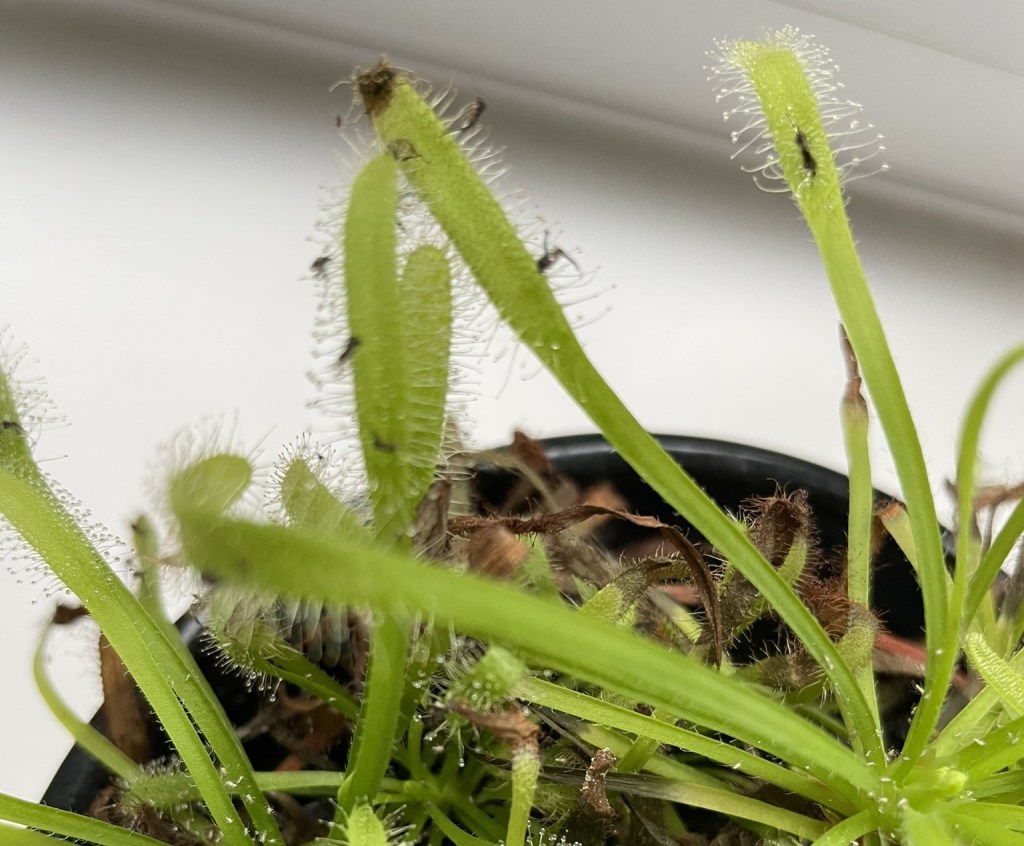
Indoors the fungus gnats continue to plague me, but did I tell you I invested in a Drosera capensis – otherwise known as a Cape Sundew. It’s a carnivorous plant and it’s catching loads of fungus gnats, but I need to invest in a few more so I don’t have to keep moving it from room to room. It likes to sit in water, and it has to be rainwater. Sometimes I’m a bit lax in topping it up, because I have to to pop outside to the water butt. However it soon lets me know as it protests by turning its leaves brown and losing its sticky glands. It can’t be too unhappy though because it’s just produced a flower!

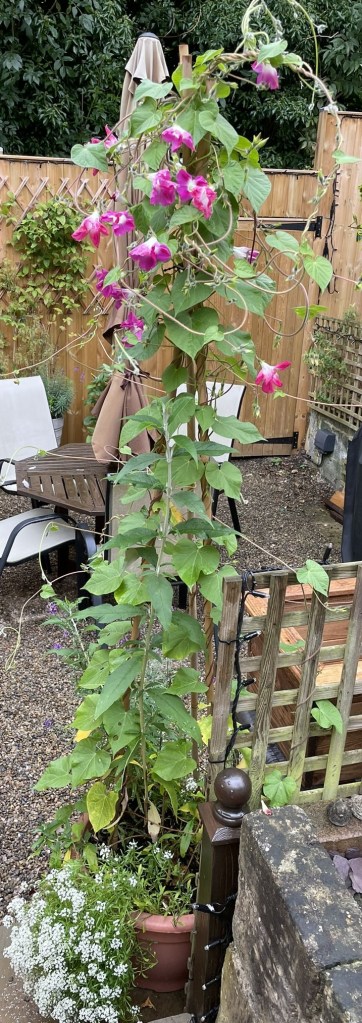
I’ll leave you with one plant that seems to have been unaffected by any insect invasions – I think you’ll agree, our morning glory is positively rampant!

Oh, and just before I really do go – Lily has been helping me mow the lawn – are green paws a variation on green fingers?!

Battles, a bodge up and a baby

Gardening can sometimes seem like a never ending battle, as some of the wildlife seems hell-bent on destroying everything us gardeners strive to achieve. I know this is not the way to think really – all wildlife has a purpose – it’s all part of the circle of life, isn’t it?

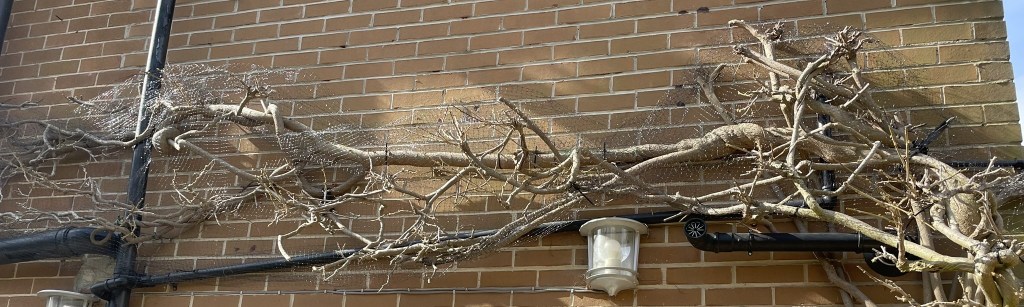
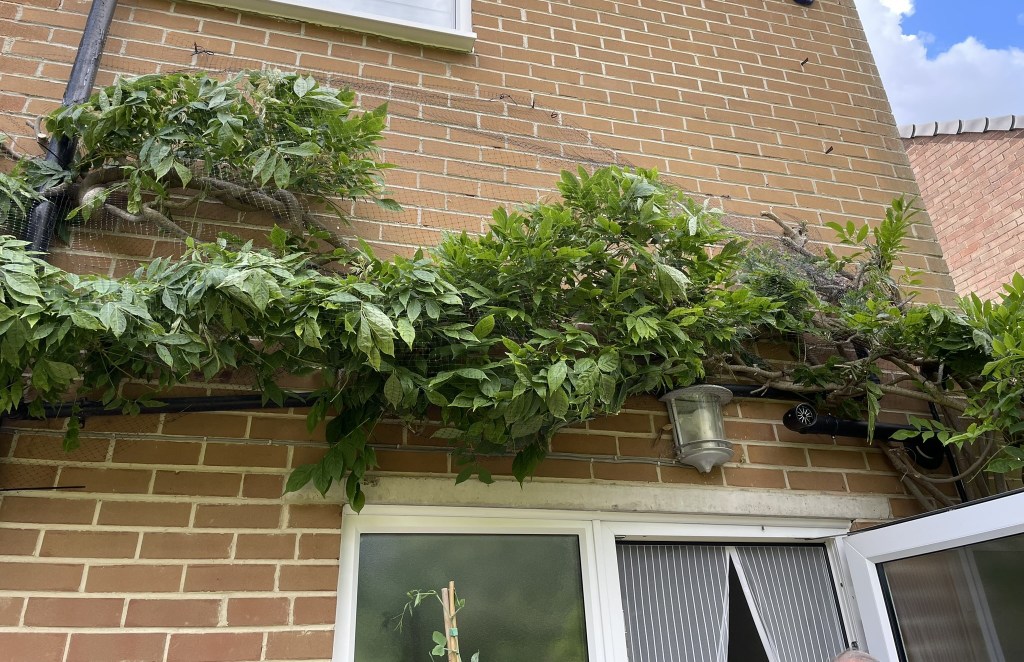
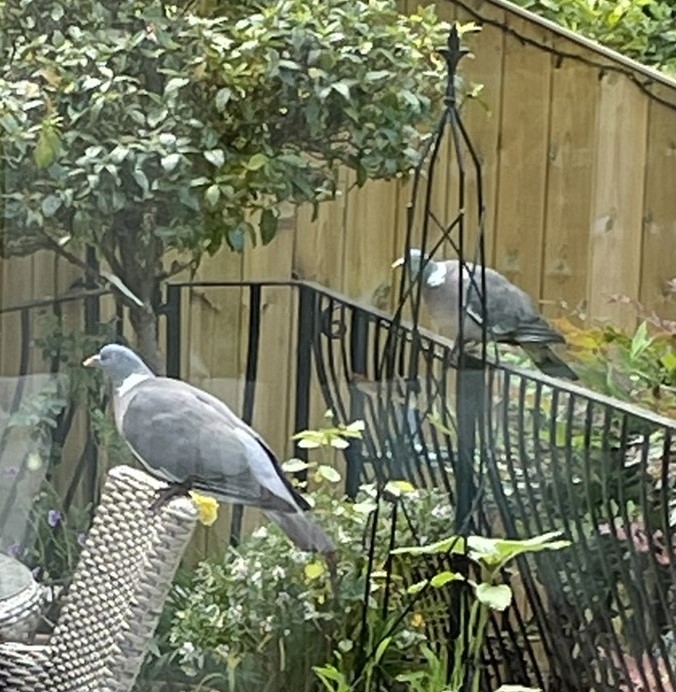
Around this time last year, I wrote about a pair of amorous wood pigeons, attempting to nest in our wisteria – you can recap here and learn a bit about pigeon procreation if you wish. Anyway they’ve returned – almost a year to the day. Well, I’m assuming it was the same pair, having another go at securing a nesting place above my back door. I really don’t have anything against wood pigeons frequenting my garden, but they do produce large quantities of poo, which I’d rather not step into when Lily and I go out first thing. I first realised they were starting to build a nest on a very windy day. Their precariously balanced twigs had blown down onto the ground.

Not deterred, they continued to swoop in with new nesting materials. This was war! I bought a long roll of netting and fixed it along the length of the wisteria – no mean feat I can tell you! I think you’ll agree this is much more discrete than last year’s fortifications!

I couldn’t help feeling sorry for them later in the day when they tried, but failed, to access the wisteria and appeared to find it difficult to comprehend. They’re now nesting in our acer in the front garden – that’s fine by me – we don’t sit under that!

So far I’ve managed to protect this year’s broccoli from caterpillar annihilation – look at the devastation they caused a couple of years ago. However, I wasn’t quick enough to spot the box moth caterpillars munching their way through my box balls or the rose sawfly larvae which had already rendered Captain Tom leafless and moved on to the Lady of Shalott. They were swiftly lobbed over our back fence with a few rose leaves to munch on.

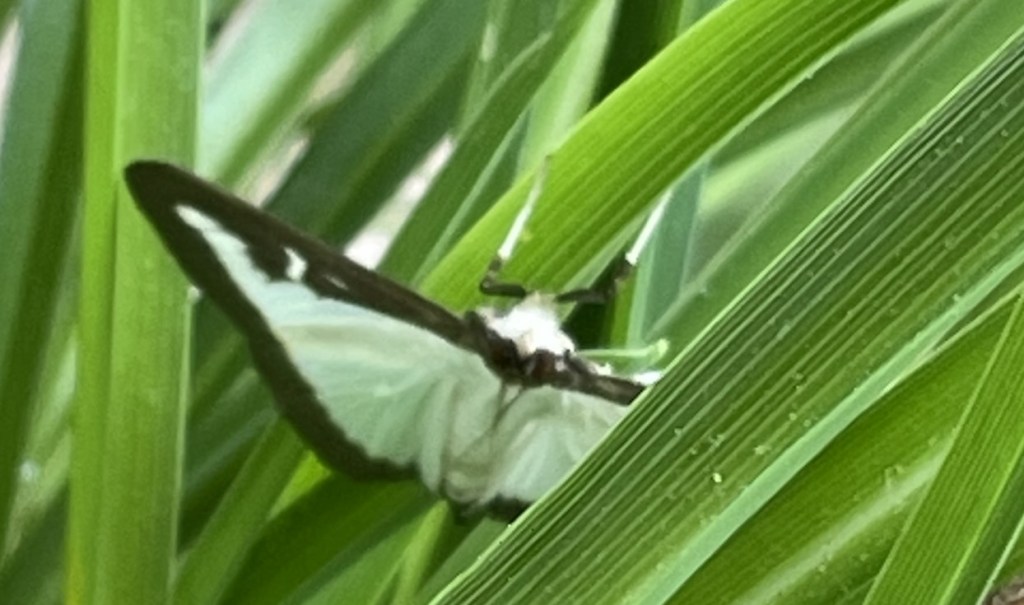
In my view the adult rose sawfly isn’t particularly attractive – it looks like a cross between a wasp and a beetle. However the adult box moth is rather beautiful – here’s one I found lurking on a day lily, very close to my box balls – no doubt looking for a mate in order to continue the devastation.

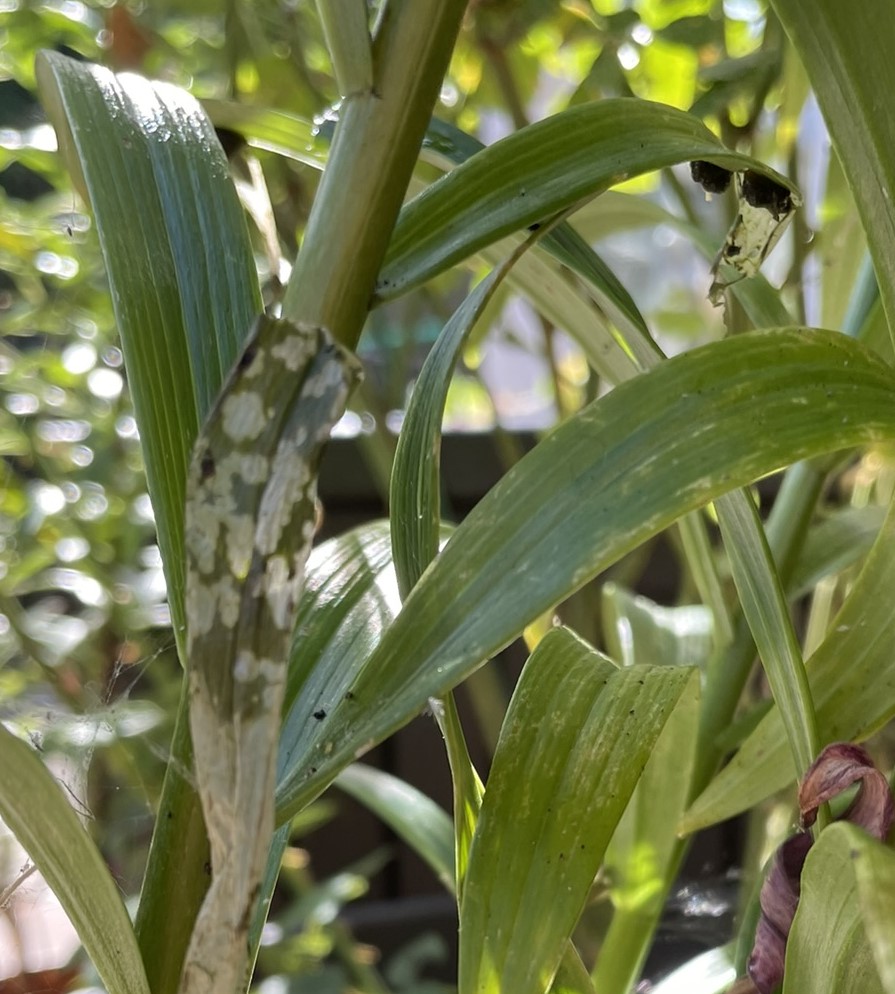
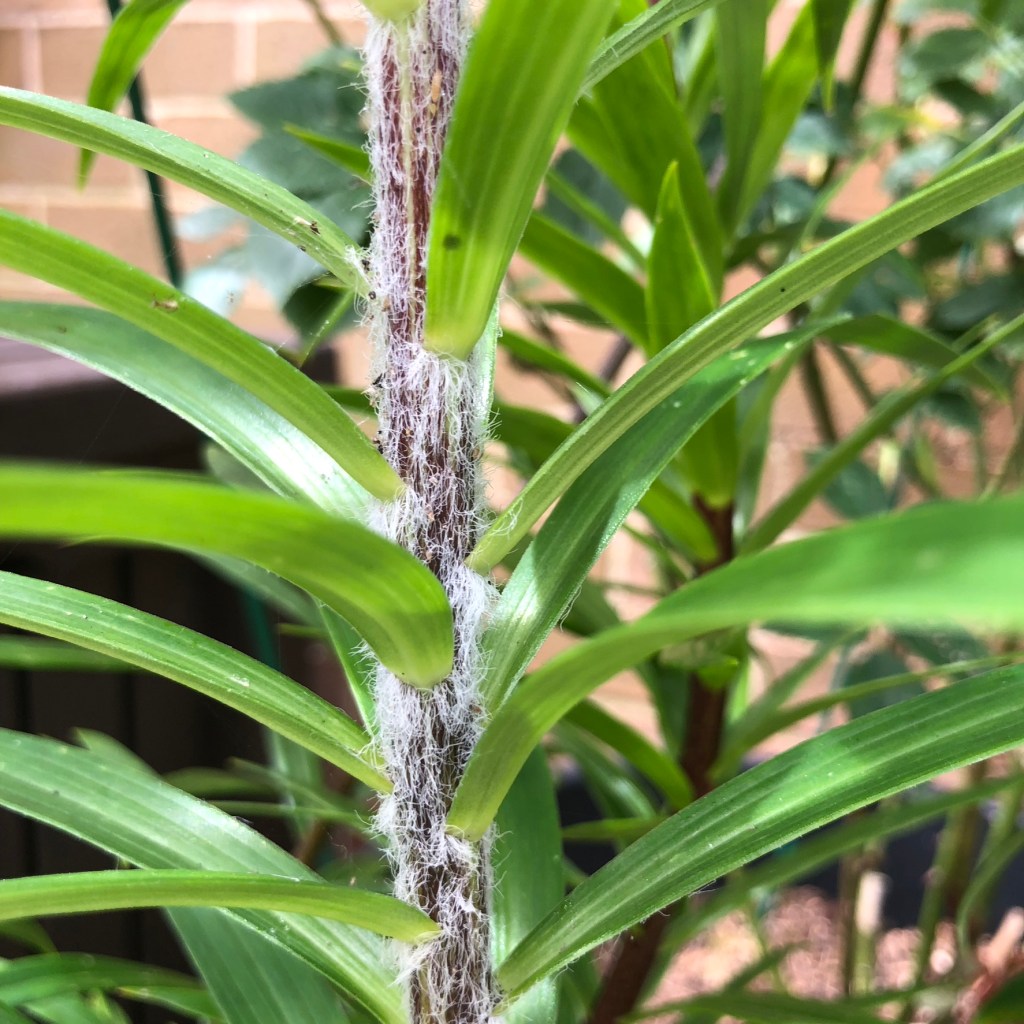
I think I fought and won the battle of the lily beetles this year and enjoyed a wonderfully colourful display. Having despatched a few of the little red bugs and their yet to develop young, I was worried when I saw that some of the stems of the lilies were covered in white fluff. I wondered if this was connected to the beetles, although I do know that they conceal their babies in their poo, and stick it to the leaves and stems. I consulted the RHS advice service and they reassured me that the fluff is a normal occurrence and nothing to be concerned about – so if you see this don’t worry!

Last week I mentioned to GR that my little hand held hedge trimmer was no match for thicker branches. Like magic its big brother appeared on the doorstep – it looks like something from the Texas Chainsaw Massacre. I was nervous of it at first but I think you’ll agree I’ve made an aesthetically pleasing job of sculpting our holly bush.

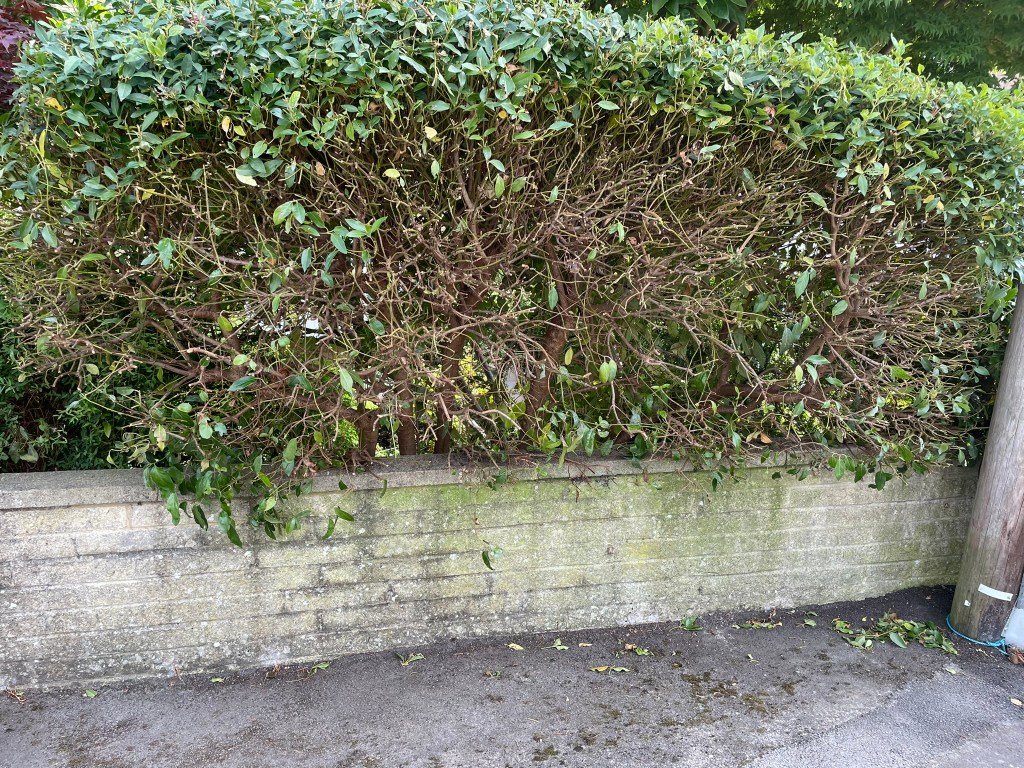
Buoyed up by my success, my next task was going to be the viburnum hedge in the front garden. However, when I got there I couldn’t help but notice the job had already been tackled. Victoria and I stood and looked, aghast. Had the Council been and cut it on account of it overhanging the pavement? But no, there were far worse examples still intact on our street. On questioning, GR proudly responded that he had undertaken the task. I am going to find a hiding place for the new hedge trimmer batteries!

Finally, I know you’ll be wanting an update on little Bud – he’s a month old now. I’ve been making sure he spends plenty of time in my garden, although he hasn’t taken a great deal of interest as yet. The patio table has proved a useful nappy changing surface and he’s done some reading of his little cloth books, while reclining in his cradle on the terrace. Do you think it might be a tad early to buy him a mini watering can and trowel?

A place to think, a bit of a stink and a wonderful excuse for a drink!

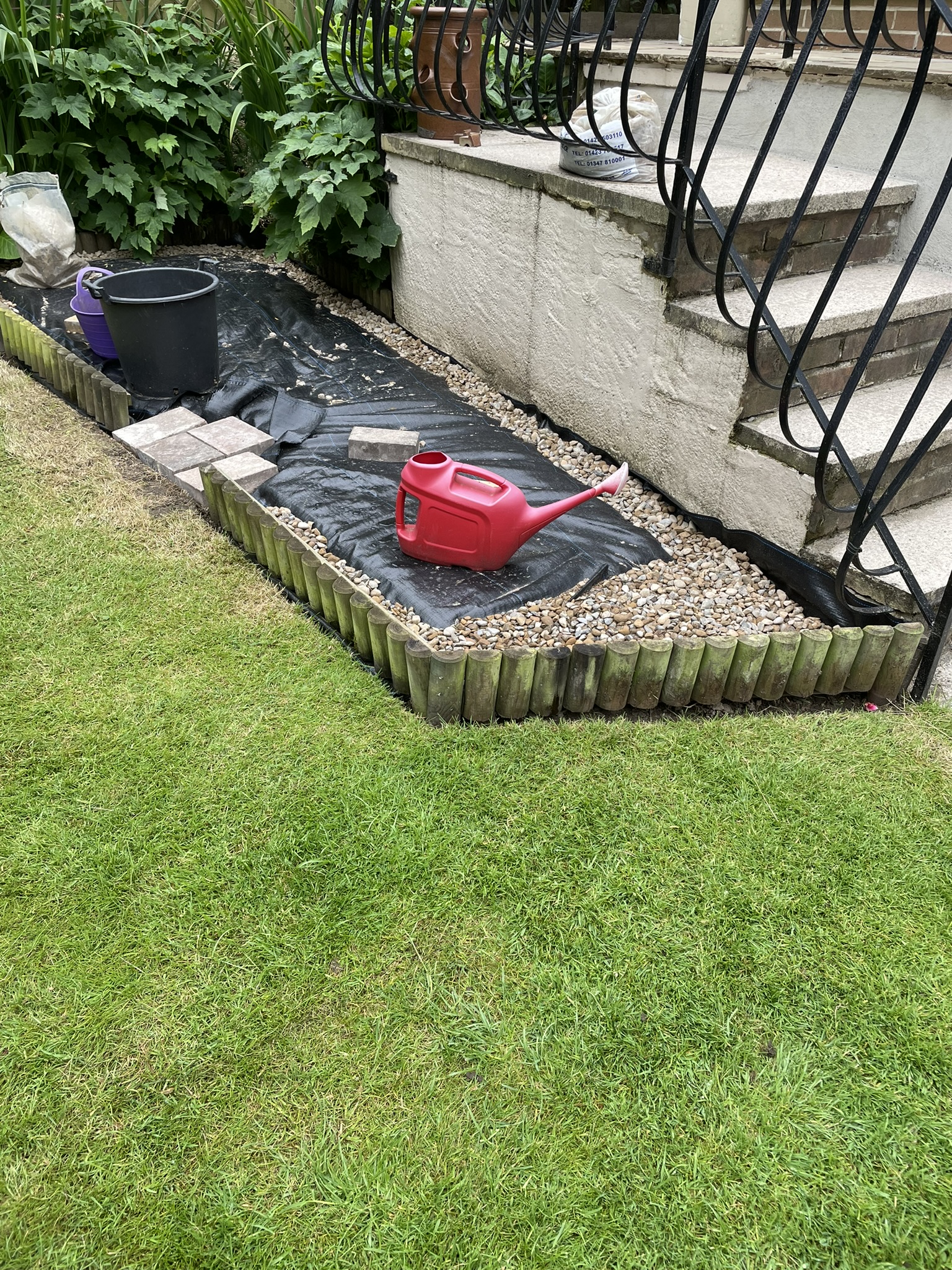
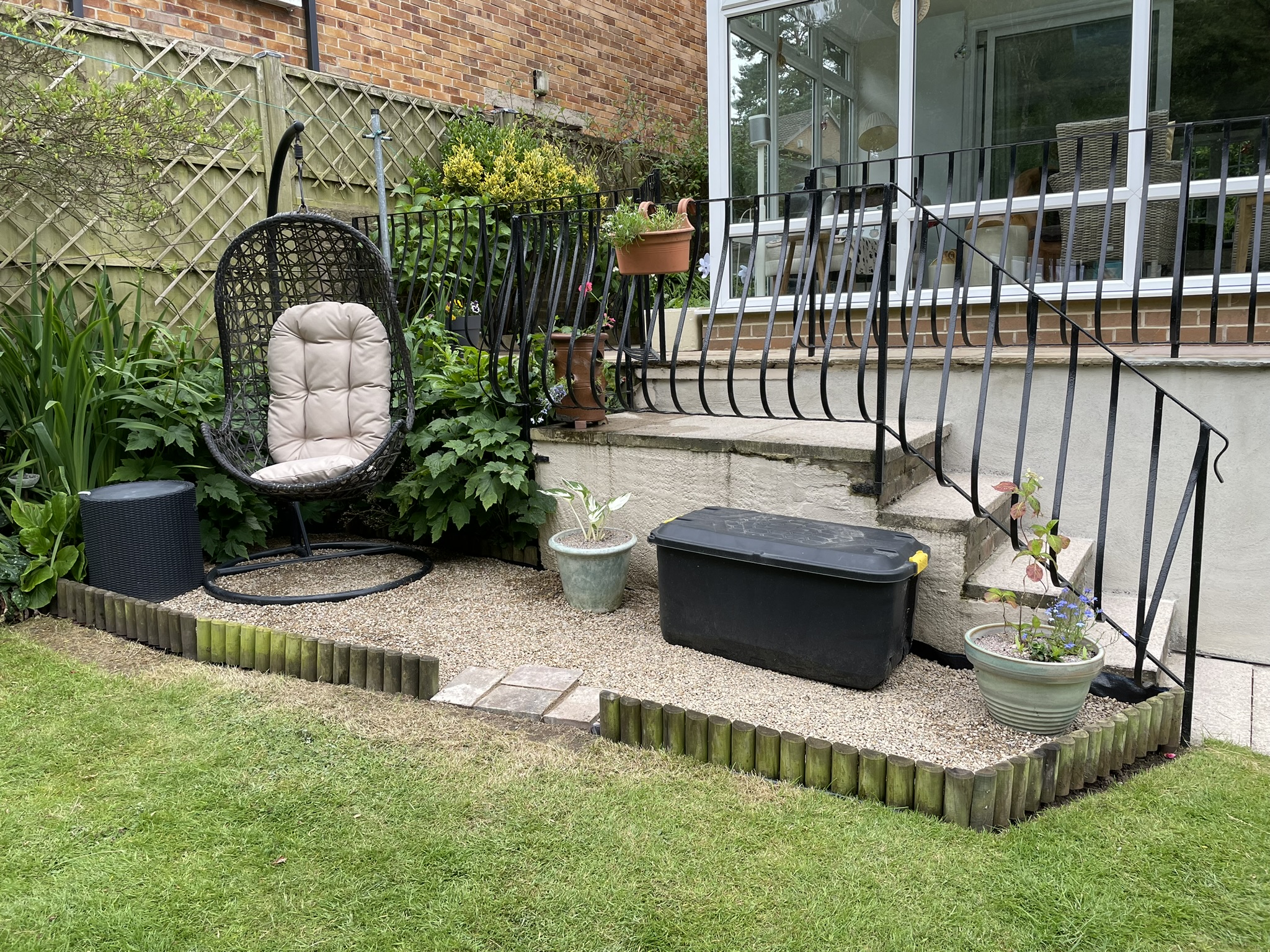
I think I might have jinxed our weather! When the sun shines in the summer (I know, a rare occurrence so far this year), it gets unbearably hot in the seating areas at the bottom of our garden. Consequently I’ve had a project in mind for some time, and I’m pleased to announce I’ve finally completed it. I’ve converted a shadier corner of our garden into my own relaxing space, where I can read, write or simply sit and think (oh, and store the lawn mower). Don’t look too closely – there are some design flaws, but I’m rather chuffed to be able to say it’s all my own work.

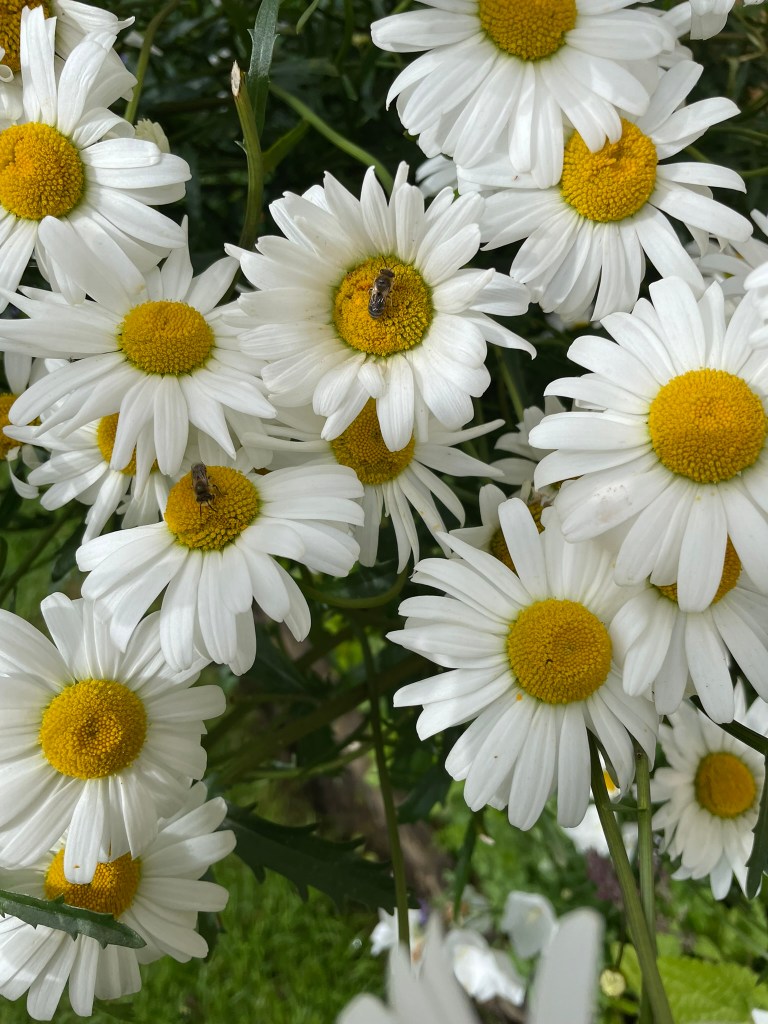
Last year I sowed some oxeye daisy seeds, and though I say so myself, they have been an outstanding success. The plants have grown to gargantuan proportions – I’ve never been the proud owner of so many daisies.

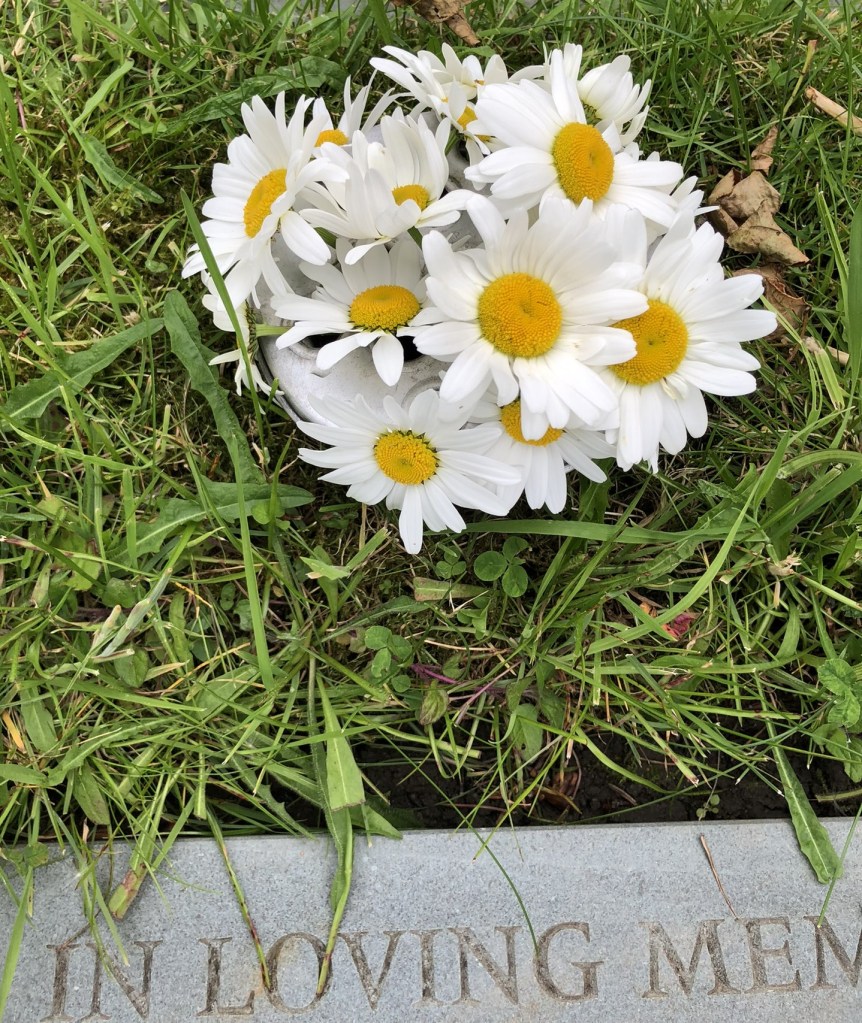
How wonderful for cut flowers I thought. I decorated my parents’ grave with them on Fathers’ Day and I proudly presented bunches to my lovely creative writing group tutor Jackie and to Victoria. In hindsight, I had noticed an unpleasant smell emanating from my bottom border, but I thought perhaps the neighbourhood cats had been making use of it. As I carried a posy round to Victoria’s, I did notice a similar smell coming from the daisies. She smelt it too but it didn’t seem too pongy. Anyway, when I next popped round, she gently advised me that they had been banished to the patio table as the smell had become overpowering. They do look very pretty out there!

This set me wondering about the smell they were giving off, so I sought a view from the excellent RHS My Advice service. I received a speedy reply from Adrian who offered the following thoughts:

Smell is often subjective and it does seem that some people find the smell unpleasant. I must admit that having just gone out and smelt the plants in my own garden I can’t pick that up, but then perhaps my nose isn’t as good as others! It’s interesting to see that flies are attracted to the plants, and this may be due to something in the scent. Your question has started a little discussion within the department, and there is a view that the plant has the common name ‘dog daisy’ because it has the unpleasant smell of dog urine! I haven’t been able to verify that yet, but the scent certainly does seem to divide opinion.

Well I can absolutely confirm that mine do not smell like dog wee, but they do smell like dog poo to Victoria and me. I hope that to my mum & dad and Jackie they are sweet smelling – I suspect not – so please accept my apologies!

And now to the most important happening of 2024! In the early hours of 4 July, Rosie and Daisy’s baby was born! We are all besotted with baby Bud and I feel sure he is already a genius. He FaceTimed us when he was only a couple of hours old and watched a Wimbledon match with me and GR, while Rosie and Daisy caught up on some sleep (his eyes were closed, but I expect he was focussing on the commentary). What better way to welcome little Bud into world than with a fizzy drink!

Ramblings from a small island

We’ve recently enjoyed a family holiday in Northumberland – me, GR, Rosie, Daisy and Lily. One of our excursions was to Holy Island. As we drove across the causeway, we were treated to a magnificent sea of pink.

Once on the island I was able to get close up to the flowers that made up the rose tinted spectacle. A quick PlantNet investigation revealed we were looking at what is commonly known as sea thrift or sea pink. Its latin name is armeria maritima. This figures, seeing as the plant grows very happily by the sea, and in this location spends a good deal of the day and night underneath it, each time Holy Island is cut off from the mainland by the tide.

Now, I bet you didn’t know this fascinating fact. Threepenny bits issued between 1937 and 1952 featured thrift on their rears! The theory behind this is thought to be that someone who is thrifty buys all they need with very little money, and threepence wasn’t worth very much. Now on our visit, someone who thought he had been thrifty on my behalf, was GR. You may recall we bought our tit box from Holy Island. There’s a man who makes them and sells them at the bottom of his garden to raise money for the church. So we paid his garden another visit and decided on a nest box for robins. GR duly placed £10 in the honesty box, visibly smug in the knowledge that this was a pretty thrifty buy, as well as being a charitable donation. After a lovely day taking in the scenery we made our way to the car park. Rosie and Daisy decided to take a detour to the public amenities. Rosie handed me Lily’s lead. I handed GR the bird box. Daisy had the car key so at the car park we waited for them in a wooden shelter. Later that evening, snug in our holiday cottage, I asked if the bird box was still in Daisy’s car. No-one remembered it being in the boot when we emptied the car, and sure enough, on checking, it wasn’t. Yes, you guessed it, it was either still on the bench in the shelter, or wending its way to a garden near you. Oh well, St Mary’s church has benefited, and in time hopefully so will a family of robins.

Thrift is just one of many wild flowers growing on the island so there were many to admire, along with the beautiful scenery. Lily loved her day out too!

I do count myself very lucky that I can go away safe in the knowledge that my garden will survive. Victoria is my garden angel. This time she diligently looked after hundreds of seedlings in my plastic greenhouses as well as my numerous plants in pots – thank you Victoria. She even sent me photos to put my mind at rest – here’s one taken in the early evening sun!

The bees are back in town!

If you’ve been reading my ramblings for a while, you may remember that last year I wrote about the bees that were mining in my back garden. If you’re new to me, or you want a reminder, you can read about them here. To cut a long story short, I didn’t think they would ever choose my garden again, after I unwittingly attempted to fill their home with gravel, not realising they were the cause of the hole that had appeared in one of my borders. Well I was wrong, they’re back! They’ve opted for an earlier check-in this year – by a fortnight I’d say. Once again I am having to reassure GR that they won’t sting him to death and that they’ll be gone soon, but he’s not happy.

Now, I’m perfectly at ease with the bees visiting my garden. I’m not so impressed by two other visitors though. I wondered why some of my strawberry plants were looking so sickly. On investigation I discovered vine weevils had moved in and munched their way through the roots – don’t they look disgusting – no wonder they’re so plump.

Whiteflies have decimated many of my beautiful pansies – frankly, they’ve left them looking ‘scabby’. Some are still stunning – but for how long? The ones below are fighting back.

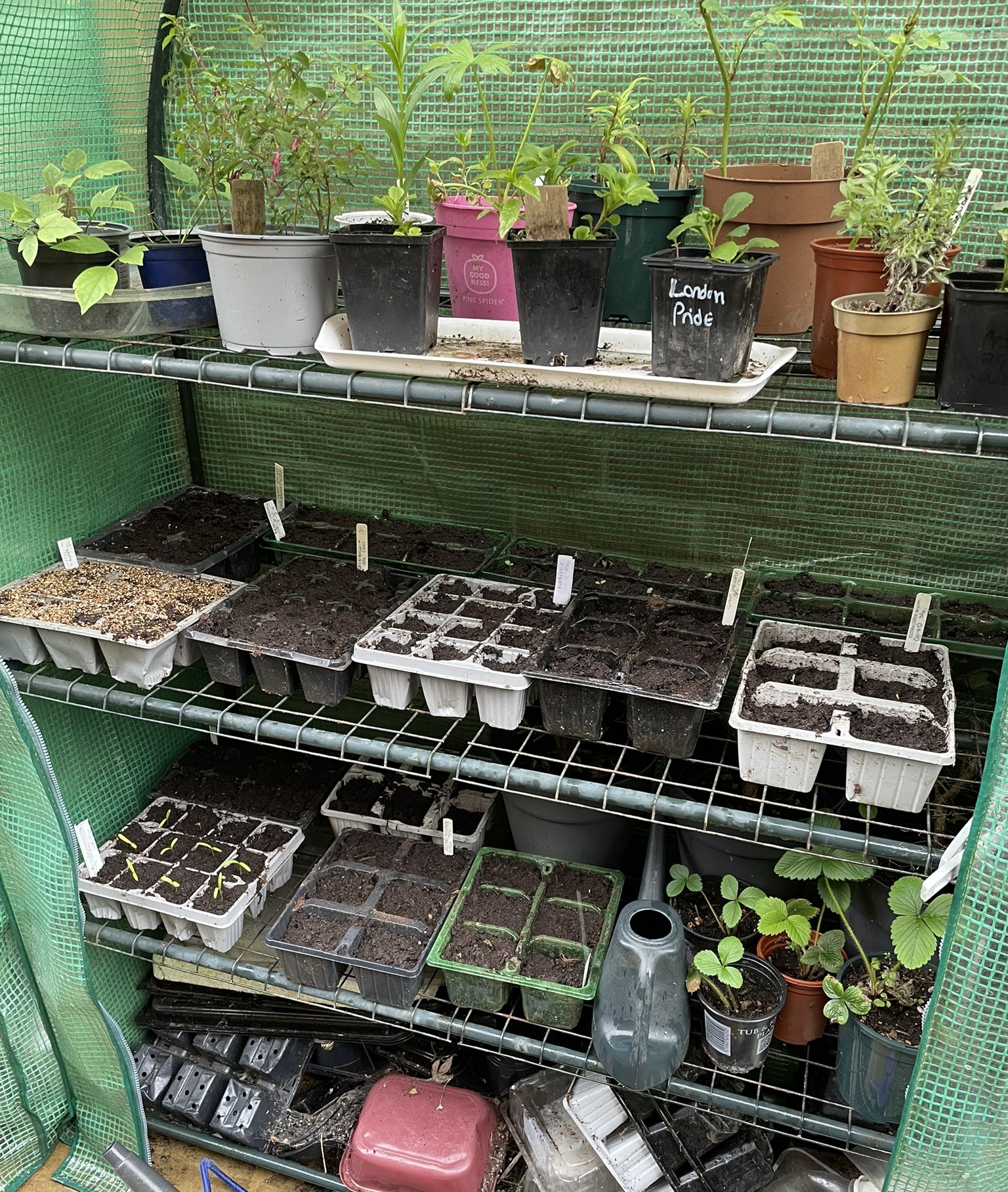
My seed growing seems to be slightly more successful second time round. The broccoli seedlings are small but look healthy enough – I don’t want a repeat of the caterpillar massacre of 2022 – remember this?! I’ve given up on mangetout this year, but I have managed to grow three fairly robust dwarf runner bean plants. Apparently slugs, snails, blackfly and greenfly love them, but if they fail in their mission to annihilate them, there are a multitude of fungal and viral diseases that will happily do the job. Courgettes continue to challenge me this year. I’ve managed to keep just one alive from my first sowing, and only one has germinated from the second. My pepper and tomato seedlings are still miniscule. I think my vision of filling one of those wooden trug baskets (beloved by the TV gardeners) with a variety of veg and salad for our tea, is a pipe dream.

Talking of my flights of fancy, I started out this month resolved to embrace No Mow May. This resolution lasted way longer than semi-dry January, but after a week I binned the idea. I set out with the notion that I would mow a heart shape in my lawn. My plan was that the rest of the grass would grow longer and longer, leaving the beautiful shorn heart shaped path for Lily and me to stroll, wee and poo on (to be clear, I was only going to do the strolling bit). Things didn’t work out the way I’d imagined. Our lawn is comprised of many different types of grass, weeds and moss, so in a matter of days the heart shape disappeared. I lost patience and mowed the whole lot, but you can get the general gist of what might have been from the photo below. I have consoled myself with the thought that mowing after a whole month would have been a hell of a job, and after all, I do No Mow October to February.

It’s been an expensive few months on the garden front – a new fence and the steps to the front door were budgeted for. What we hadn’t bargained for was the collapse of the rendering from the ten meter long wall below our terrace. It’s been replaced now, but it’s a good job GR has started working for a living again after all his skiing jaunts!

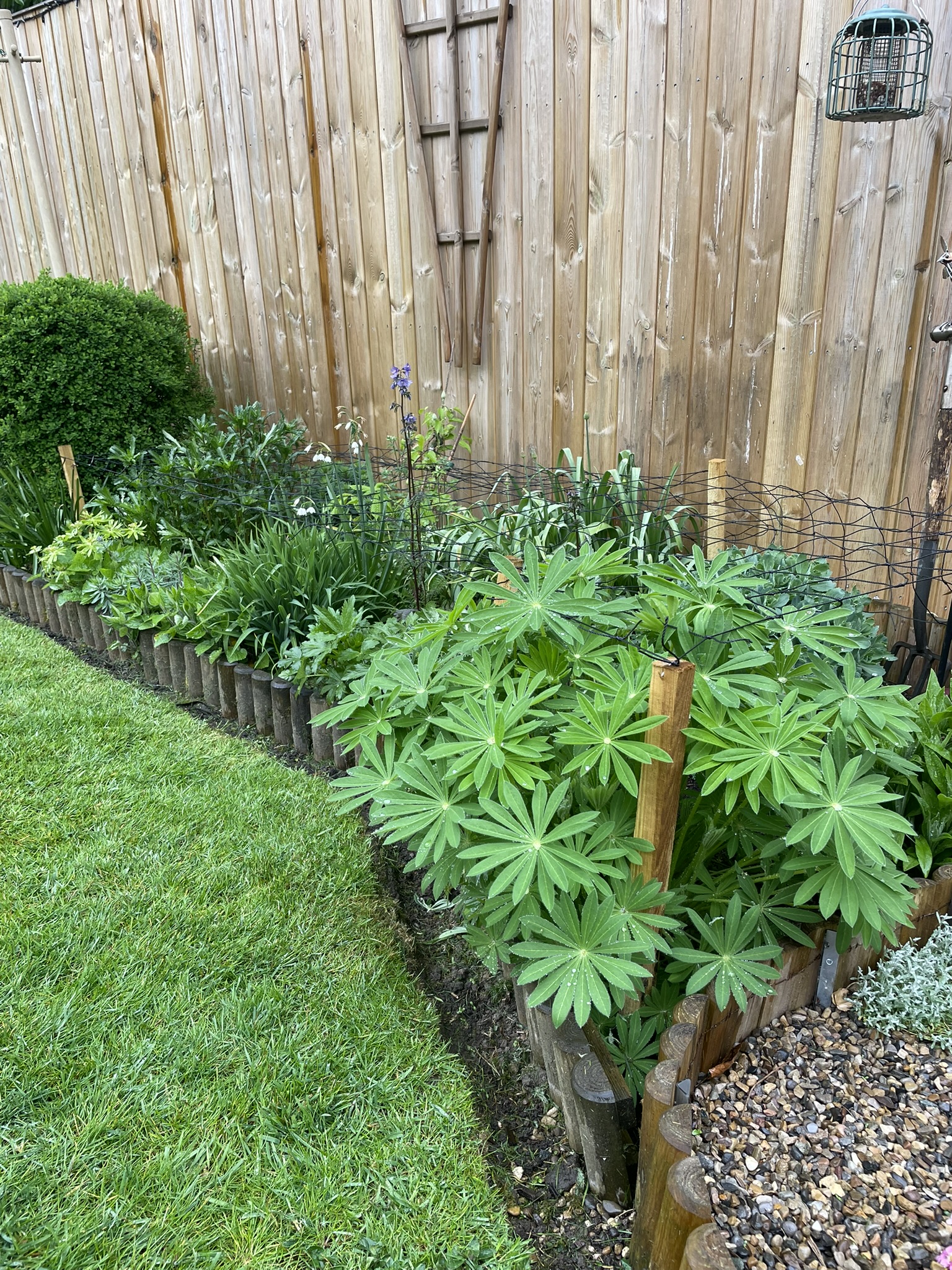
Not everything has gone wrong in the garden. Just look at my ceanothus! Despite all the traumas over the winter, it has put on a magnificent display and looks stunning against the hawthorn blossom. The wisteria has survived the new fence and is making a valiant attempt to camouflage the drainpipes – it’s scent is intoxicating. My little lilac tree is also giving out a delicious aroma and my new clematis plants are putting in a good effort, although they are a bit vertically challenged at the moment – they need to get climbing!

Ups & Downs

Well it’s all been happening since my last post! First a blocked loo. Due to the ridiculous way our drains are configured, not helped by someone in the past (not us), building a conservatory over one of the drain covers, it took the wonderful Homeserve team over a week to clear the blockage – a week that felt both stressful and undignified. At each return visit they brought more and more equipment to aid their drain explorations, including two different types of camera and a probe that could navigate pipes by itself!

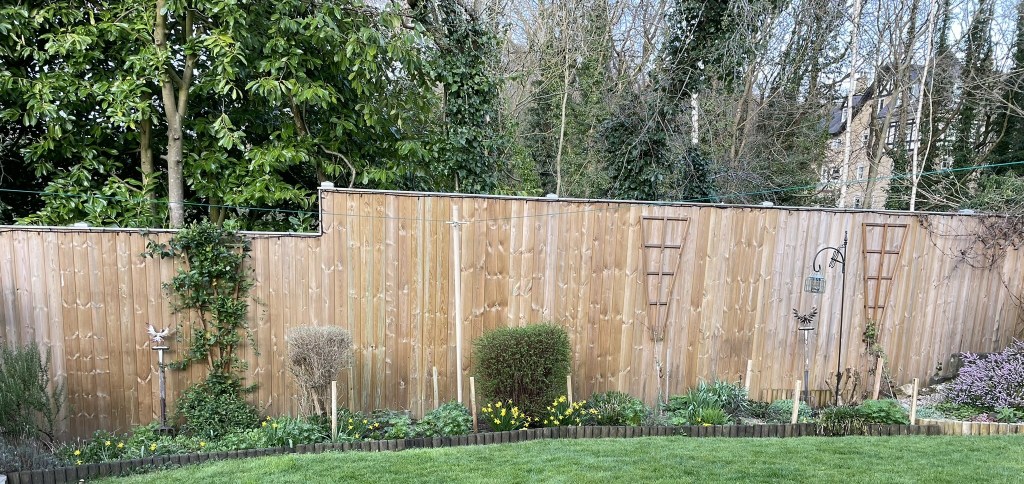
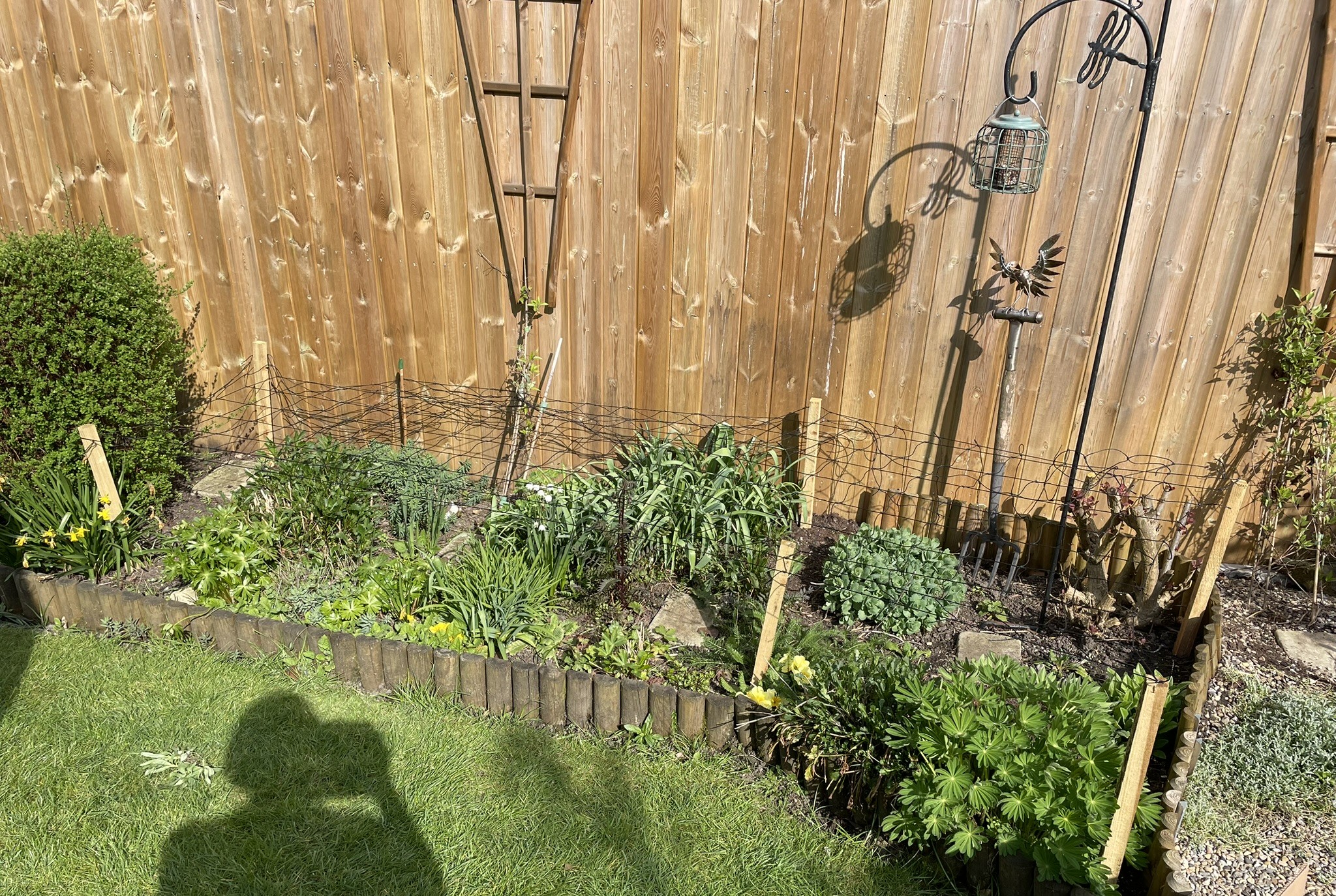
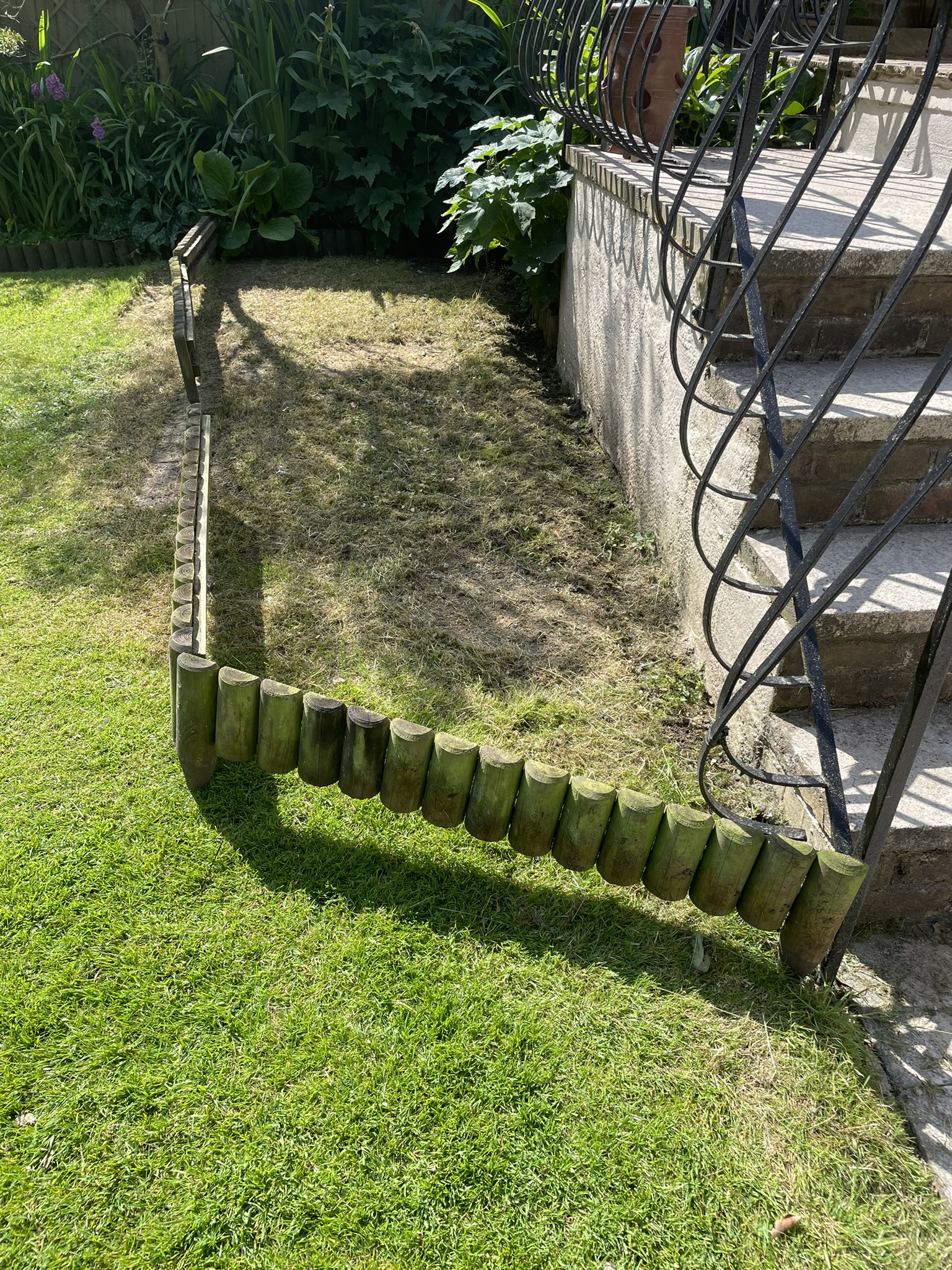
Then the lovely new fence crew arrived. The first day they dismantled the fence at the bottom of the garden, behind my herbaceous border. It rained all day. They valiantly ploughed on. Their large steel-capped boots reduced my border and the lawn to a pulp. A large area of forget-me-nots was buried under thick clay and my admittedly rotten log roll edging, disappeared into the quagmire. By some miracle my sedums and most of the alliums lived to tell the tale. By the end of Day 1 most of the bottom fence had been replaced and I could already envisage how good it was going to look compared to the old one.
Thankfully the sun came out on Day 2. They removed the side fence and began the complicated task of building a new one up a steep slope. Day 3 included the tricky operation to cut the fence to fit round the thick trunk of our wisteria, which protrudes into next door’s garden. They did an amazing job and some fairies were so impressed they’ve moved in.

No sooner had the fence job been completed than the next one commenced. We’re having some steps built to ease navigation of our black-run drive. Talking of which GR is now on his final ski-ing jaunt of the year.

While he’s been away I’ve been trying to return the back garden to some semblance of order. I’ve planted 72 perennials in the bottom border, replaced the rotten log roll and put trellis up ready for some climbers. My seed growing thus far this year has been a dead loss. You may recall that since smartening up our conservatory, I had taken over the corner of a shelf in our utility room, to grow my seeds. Unfortunately there wasn’t enough light, so growth was tall and spindly, and most of the seedlings withered away. I normally have great success with my courgettes but look at these pathetic specimens! Anyway I’ve chucked the whole lot out and started again. I’ve rearranged the utility room and moved the propagators nearer the windows, so fingers crossed.

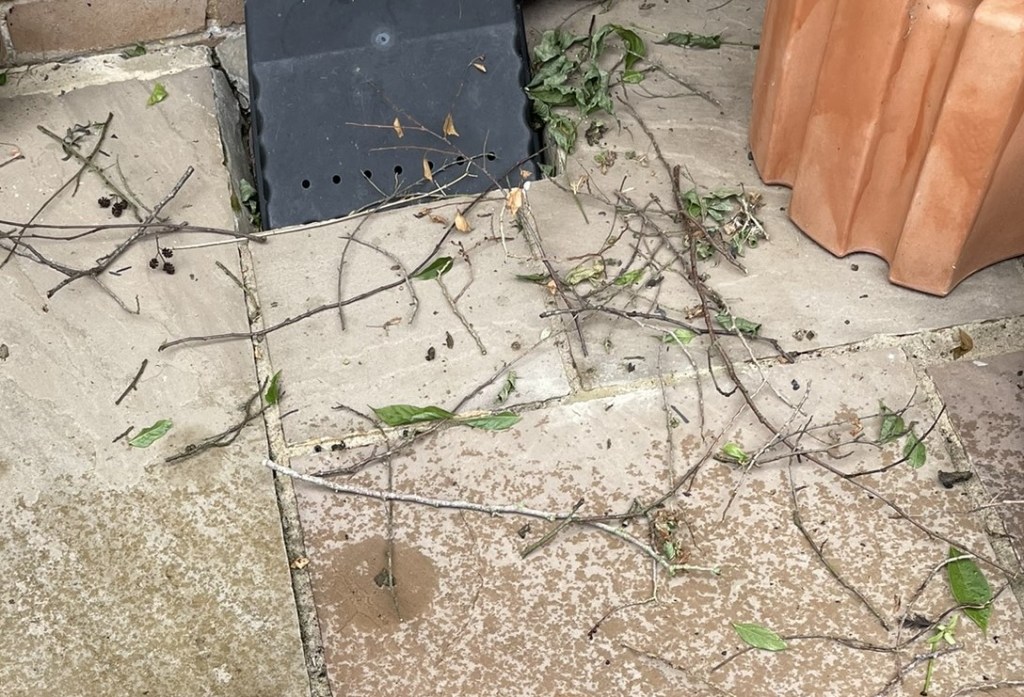
Yes, it’s official, the blue tits are exceedingly busy getting their nest ready in the bird box. There’s frenzied tapping coming from inside as they hammer all their little bits of foliage and fluff into a cosy bed ready for their babies. They carry huge amounts of moss in their tiny beaks and then try to stuff it through the small hole in the nest box. Most of it falls down onto our storage box below, but they do gather it up again.

By the way those 4 pots are lavender. It looks like only 2 will survive (do you remember I potted up loads of seedlings from the front drive) – still, two free plants are better than none!

And finally, do you remember my blog about all the palaver involved in getting your poinsettia to produce red bracts in time for Christmas. I was too late to trial the advice, but mine has done it all by itself. Yes, I know, wrong time of year, but who knows, Easter might be the new Christmas where poinsettias are concerned.